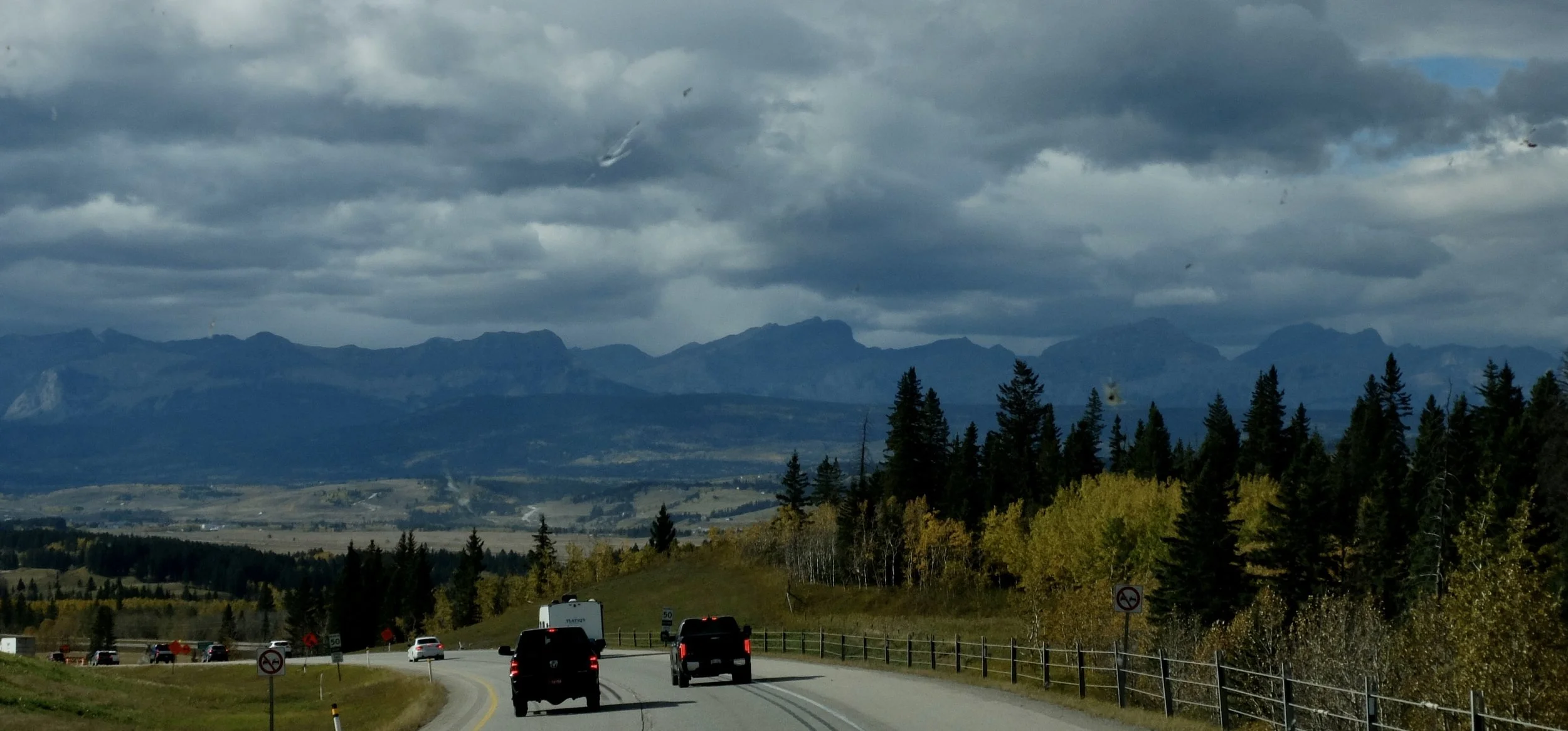
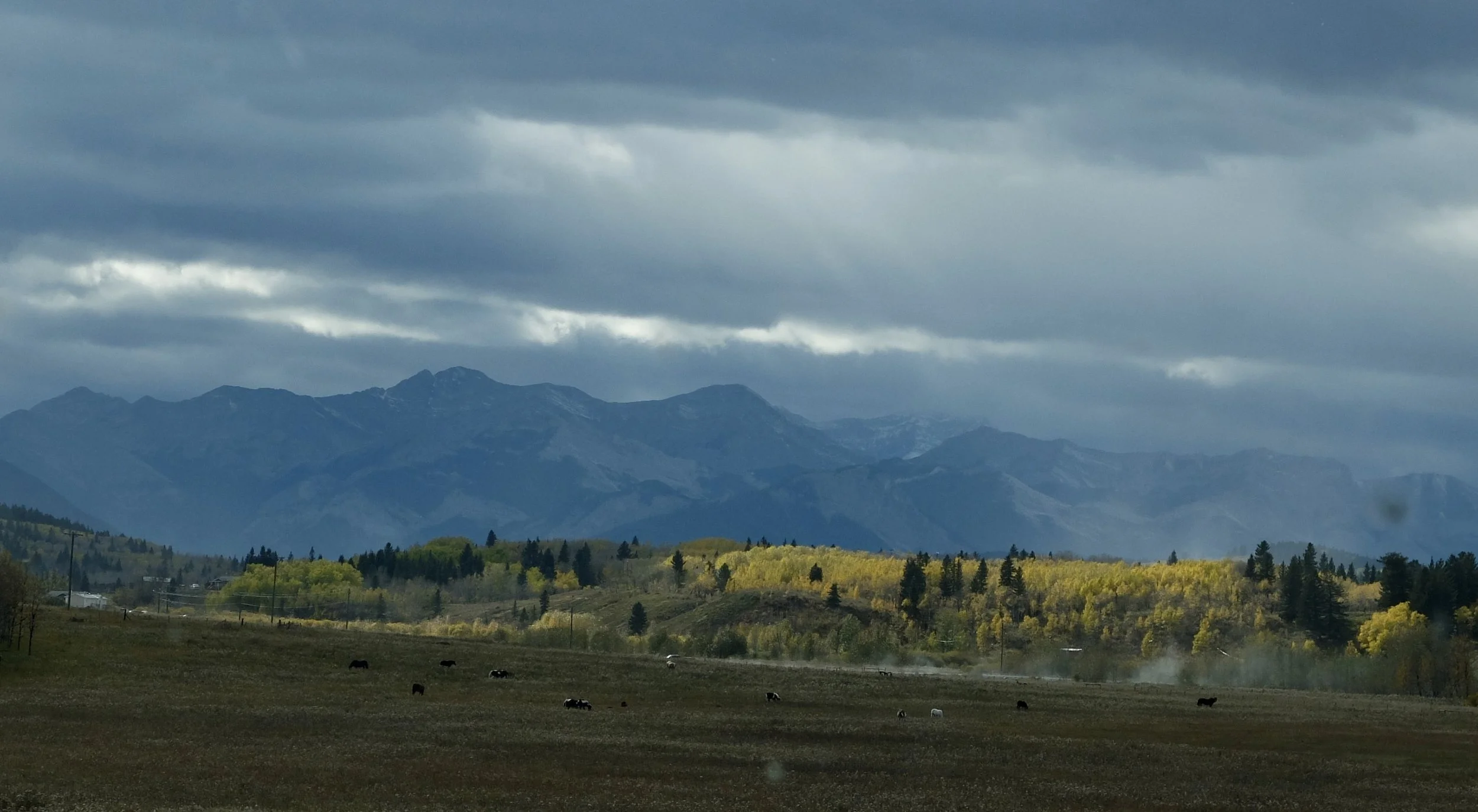
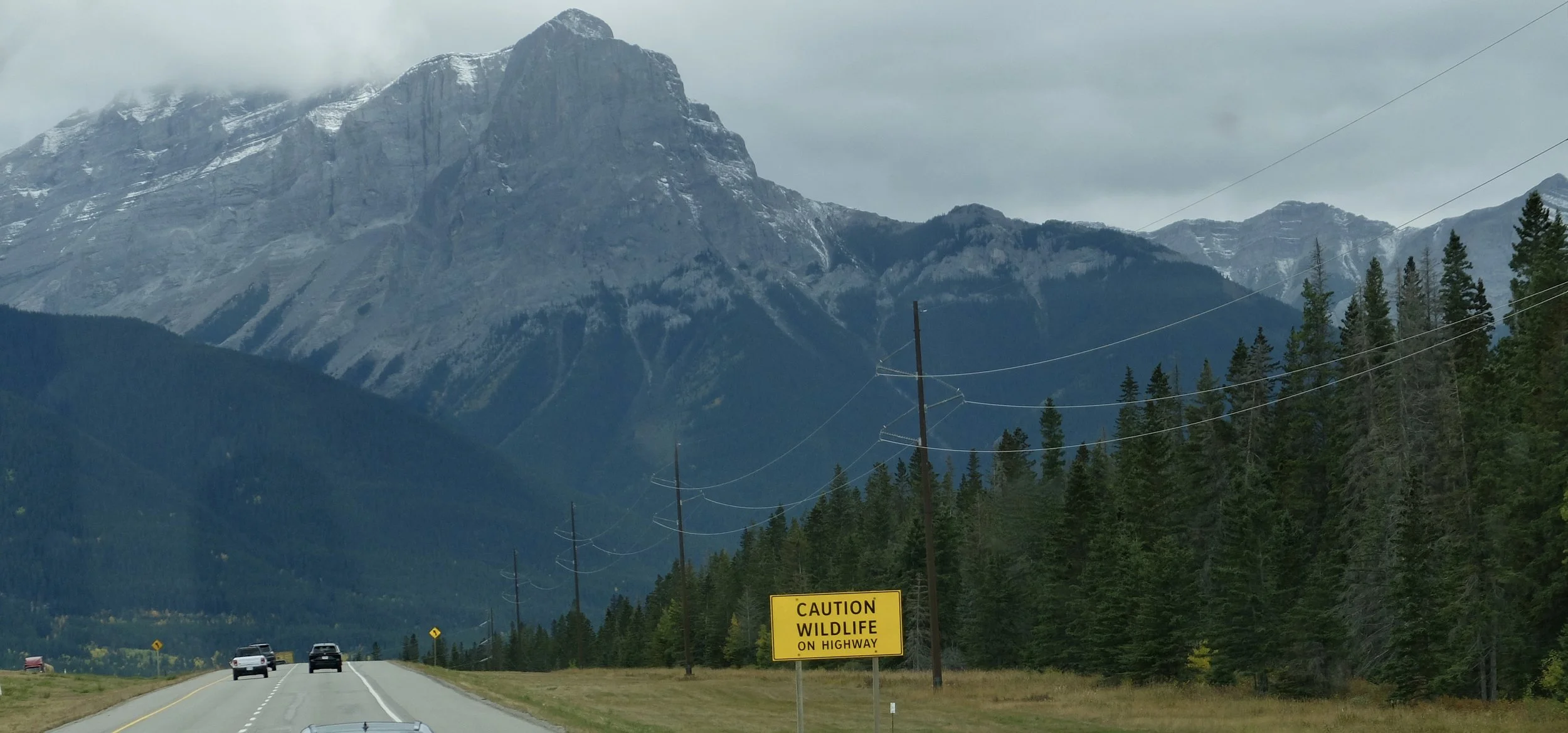
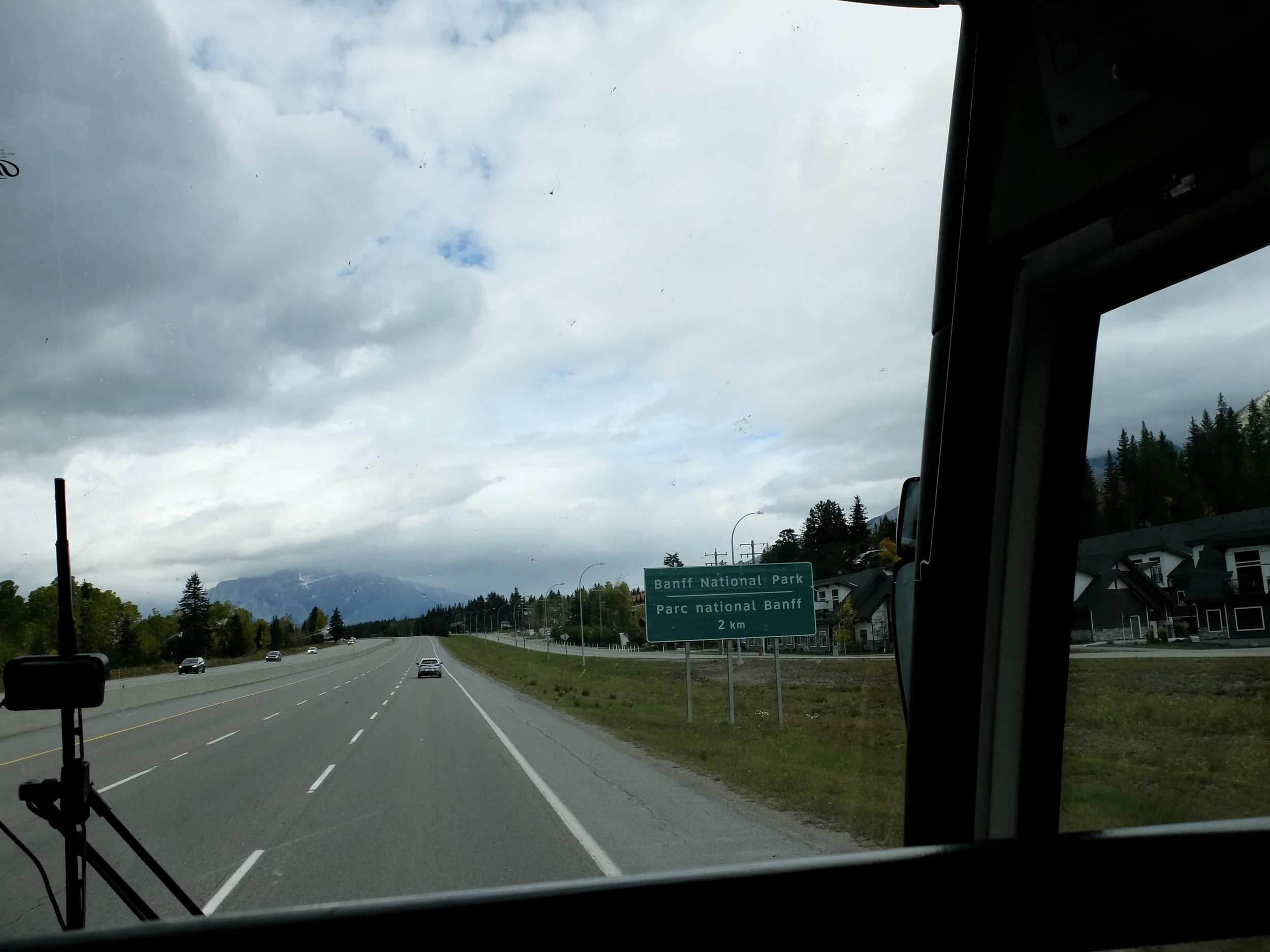
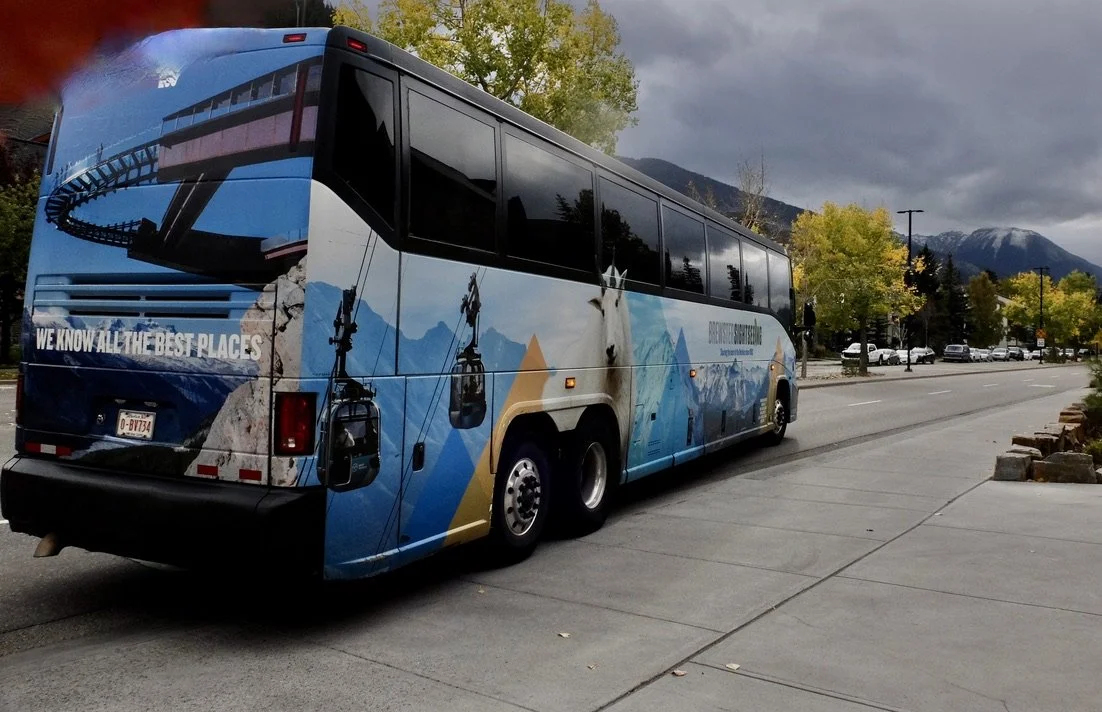
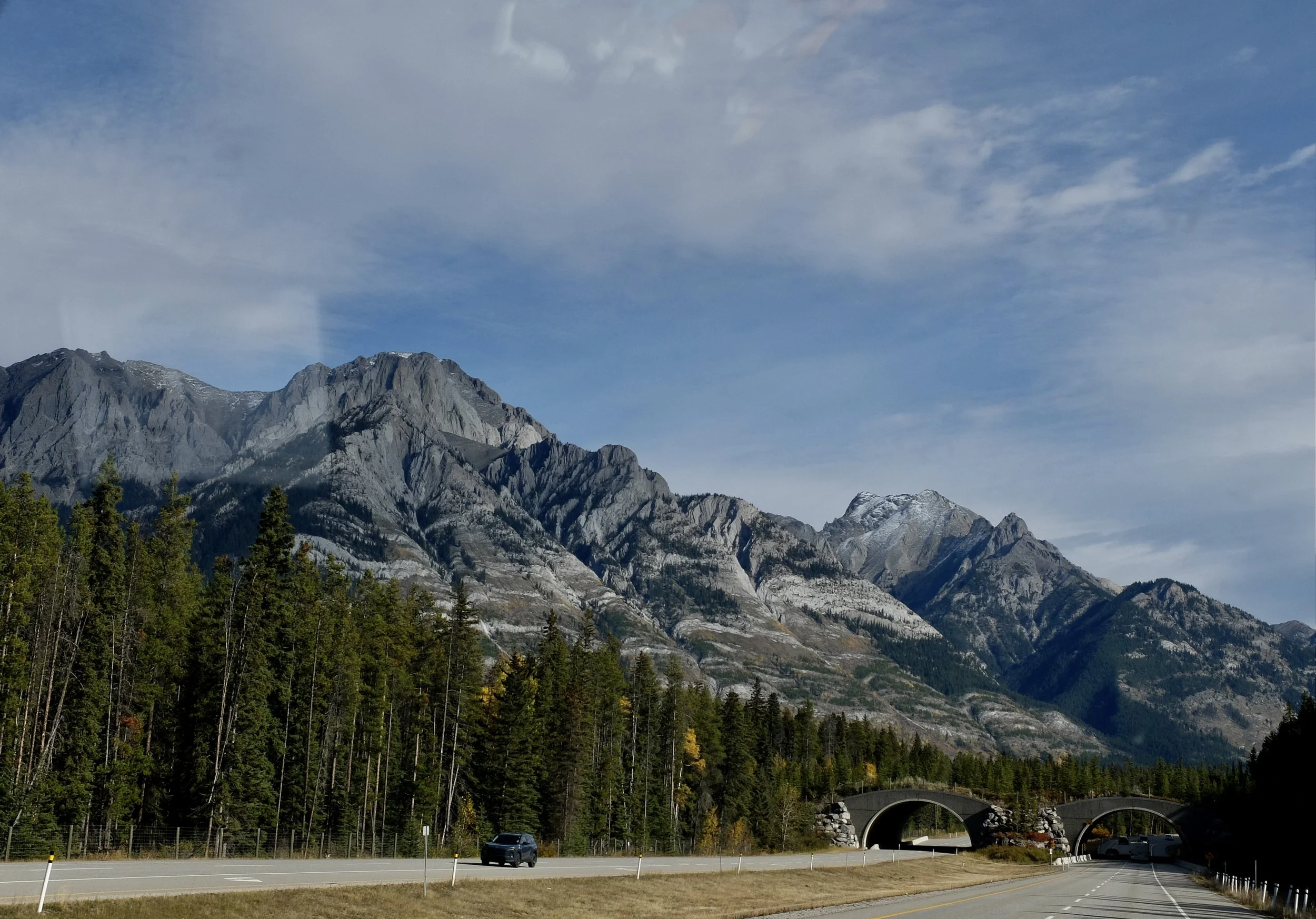
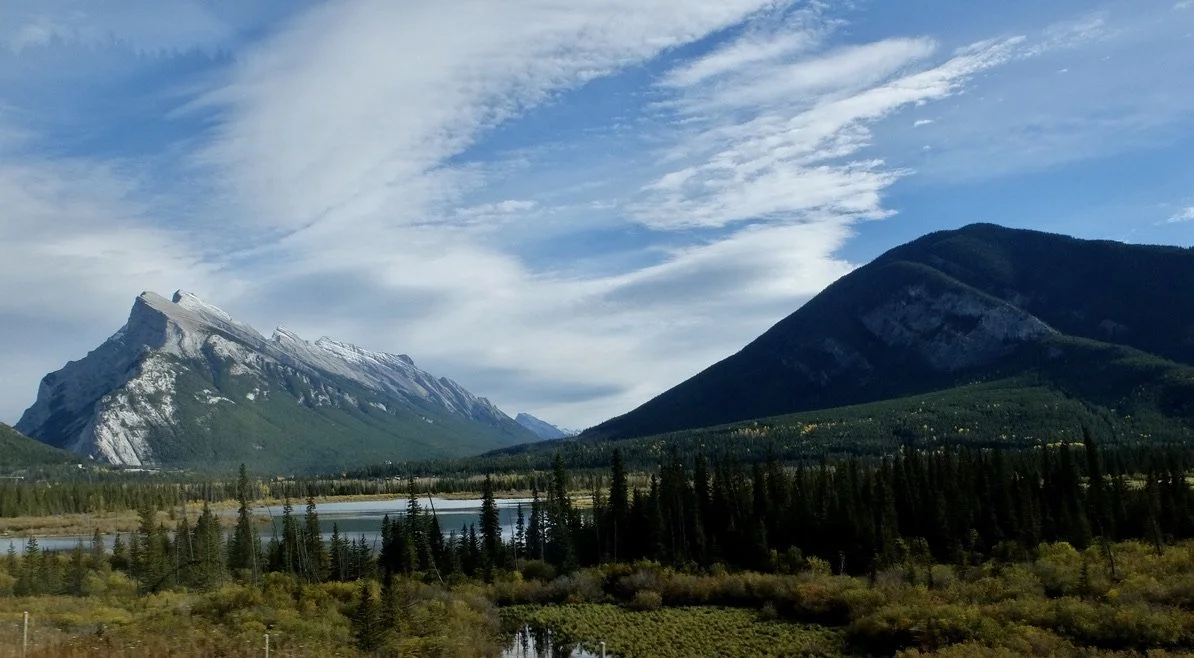
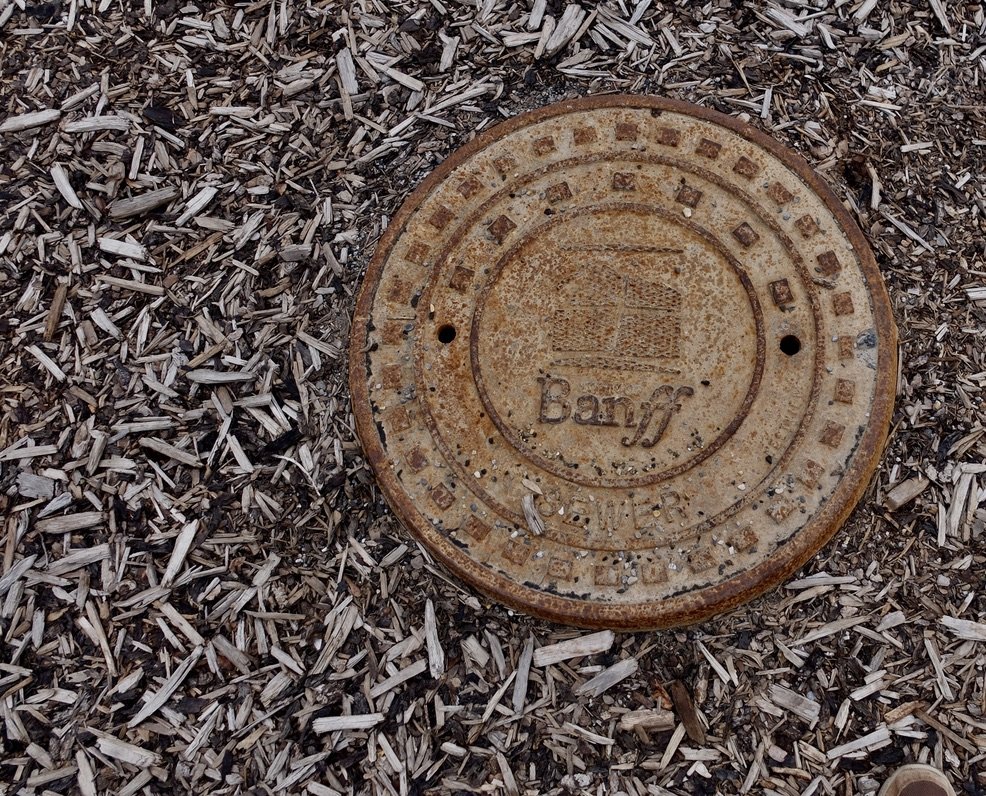
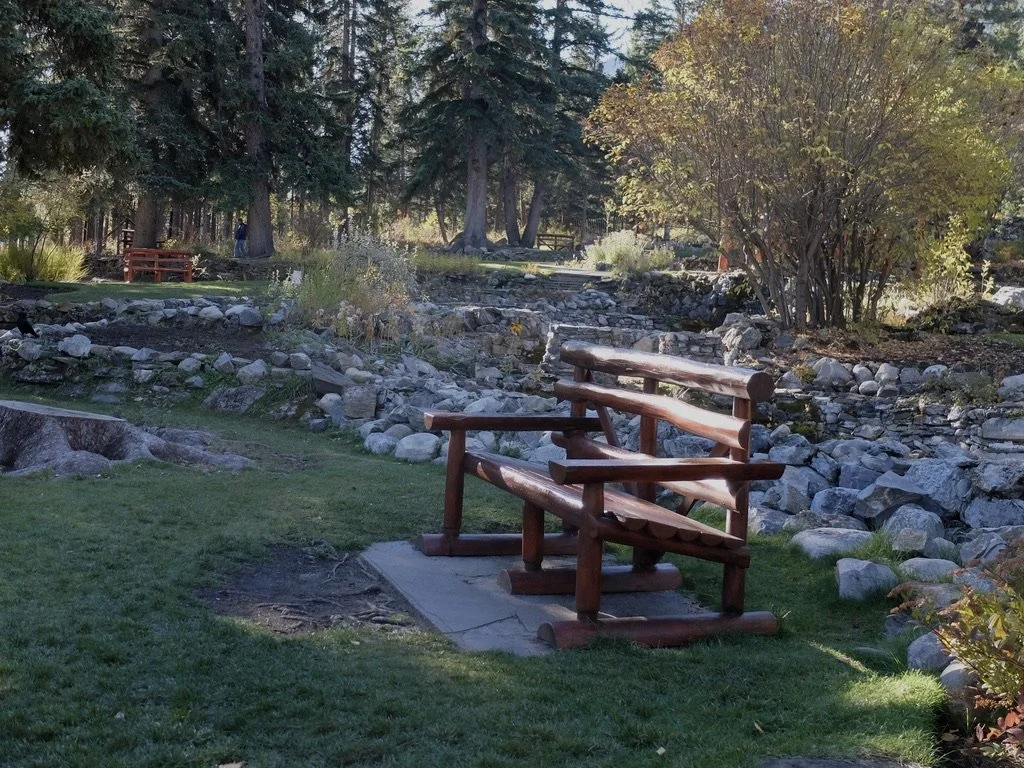
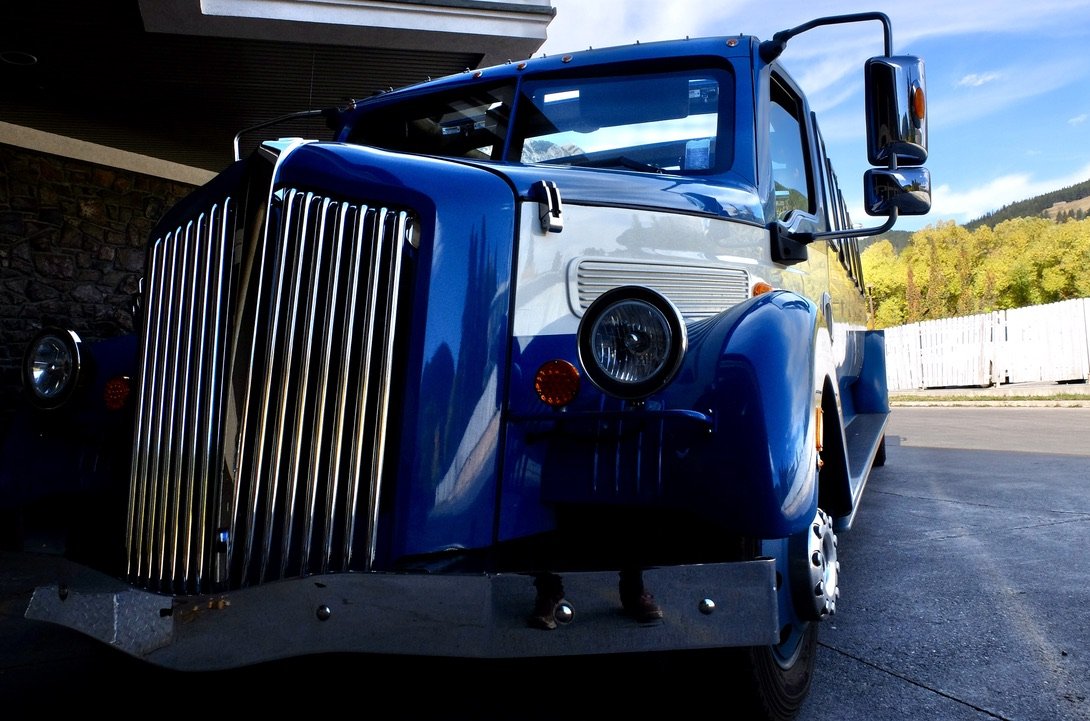
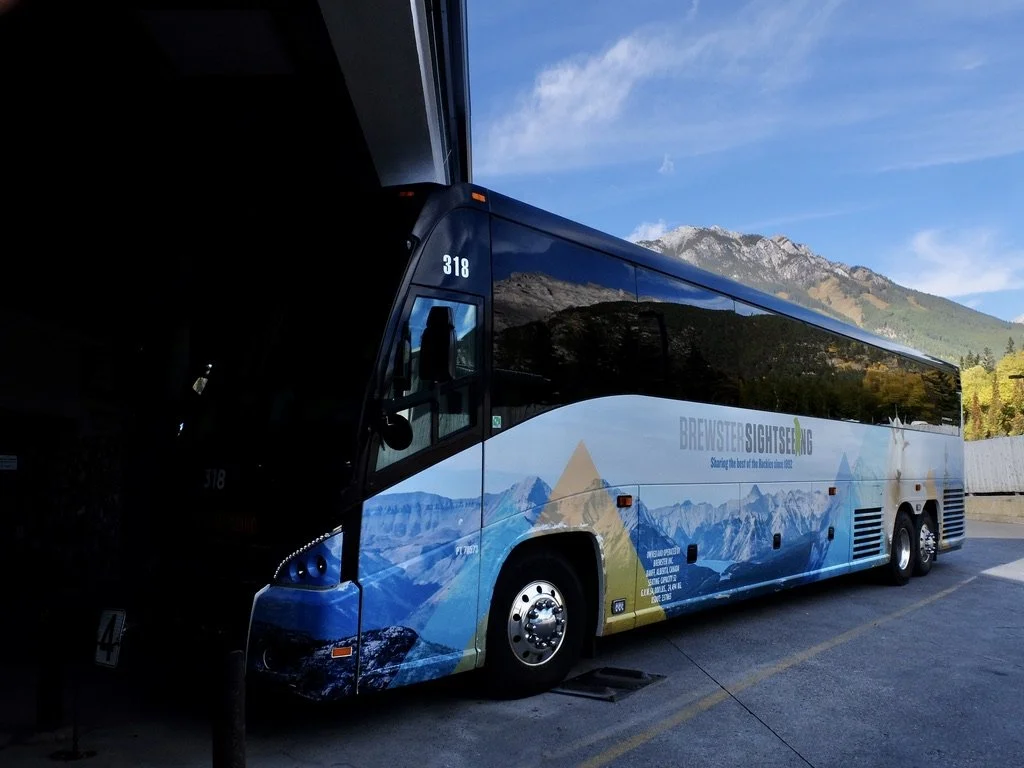
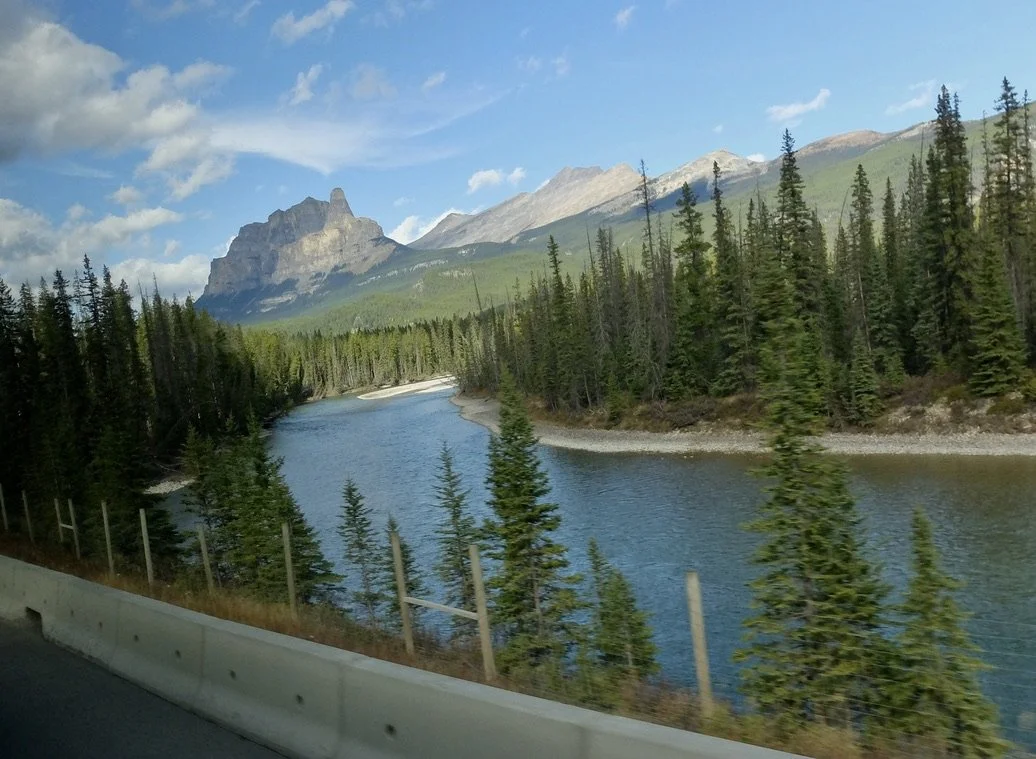
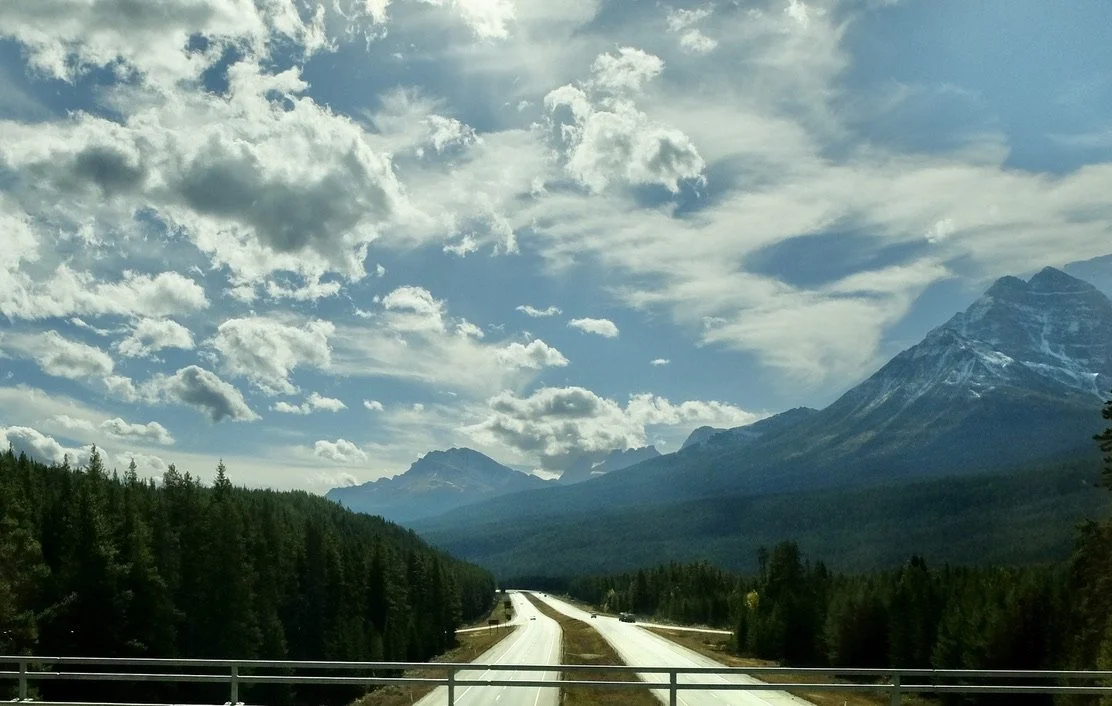
At the Calgary Airport we walked to the Brewster Desk where our bags were tagged & we were told to arrive back in a bit for the bus to Banff. Time for coffee & a Canadian style pastry treat. Luckily I got a seat up front & the windshield was clean.
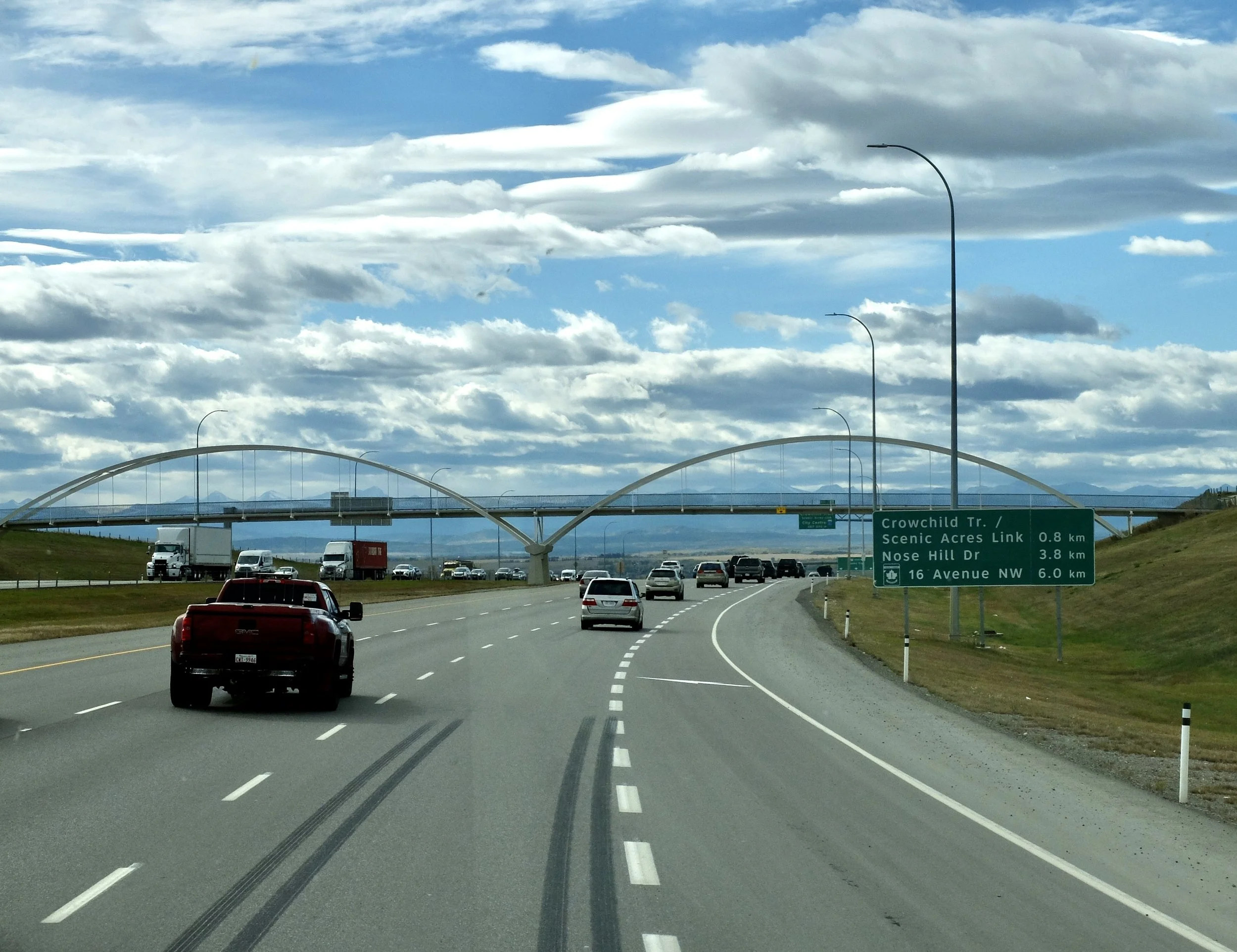
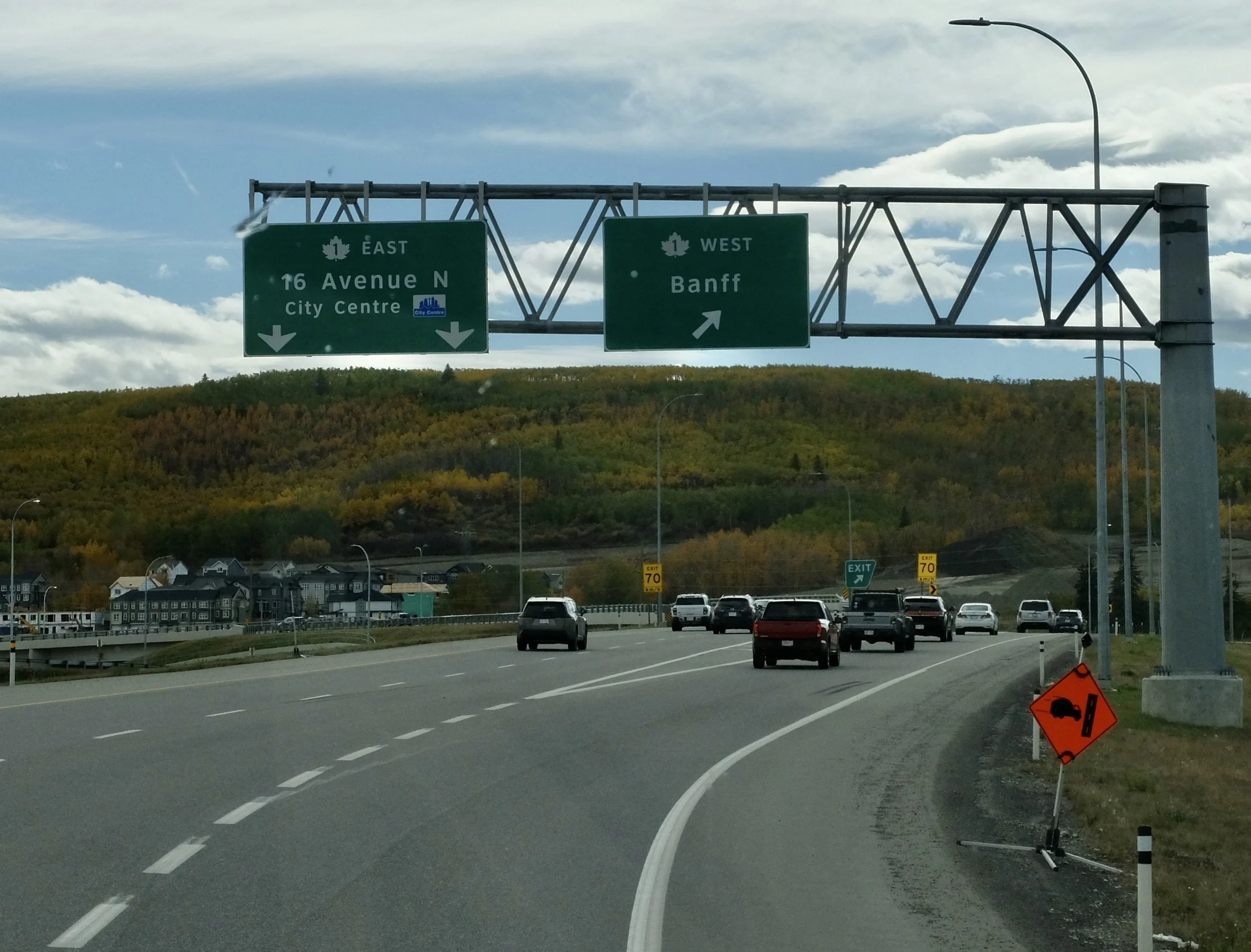
About 1.5 hour drive from Calgary airport to Banff with Brewster Express bus on the Trans-Canada Highway. The highway was constructed between 1950 & 1971 “…& going through all ten provinces making it one of the longest routes of its type in the world.”
At first I thought this orange sign meant “Do not drive your truck into a wall.” Trans-Canada Highway.
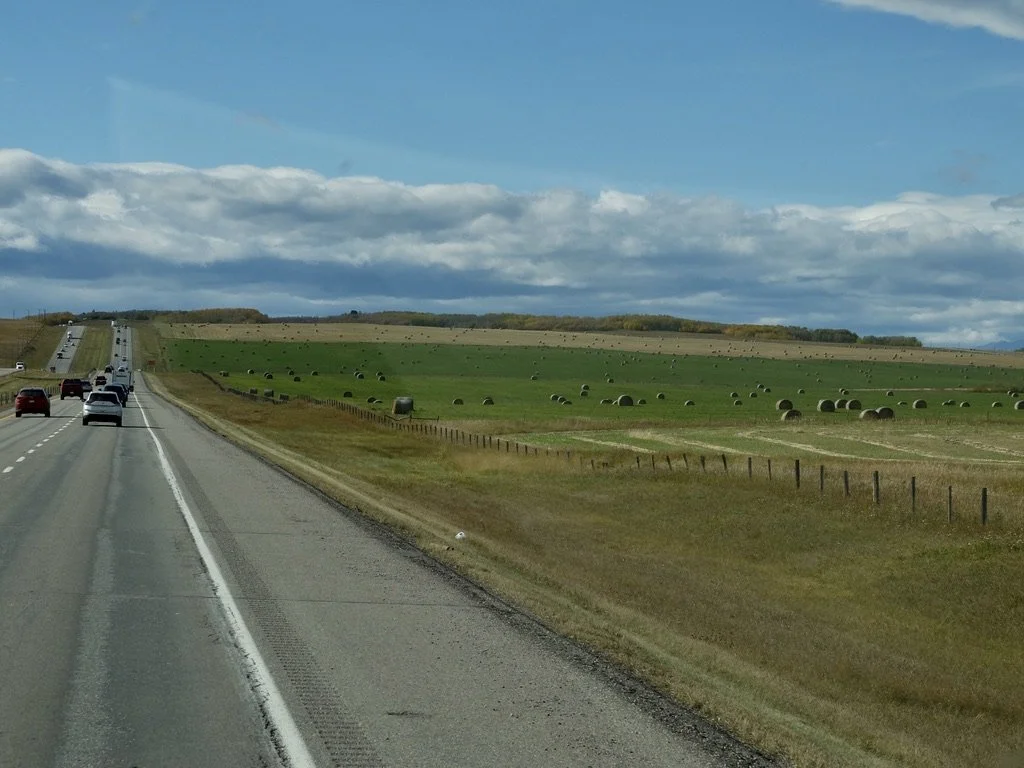
Ranch land on Trans-Canada Highway about half way to Banff. I liked that for the most part the rolled bales of hay we saw were not encased in a plastic wrap.
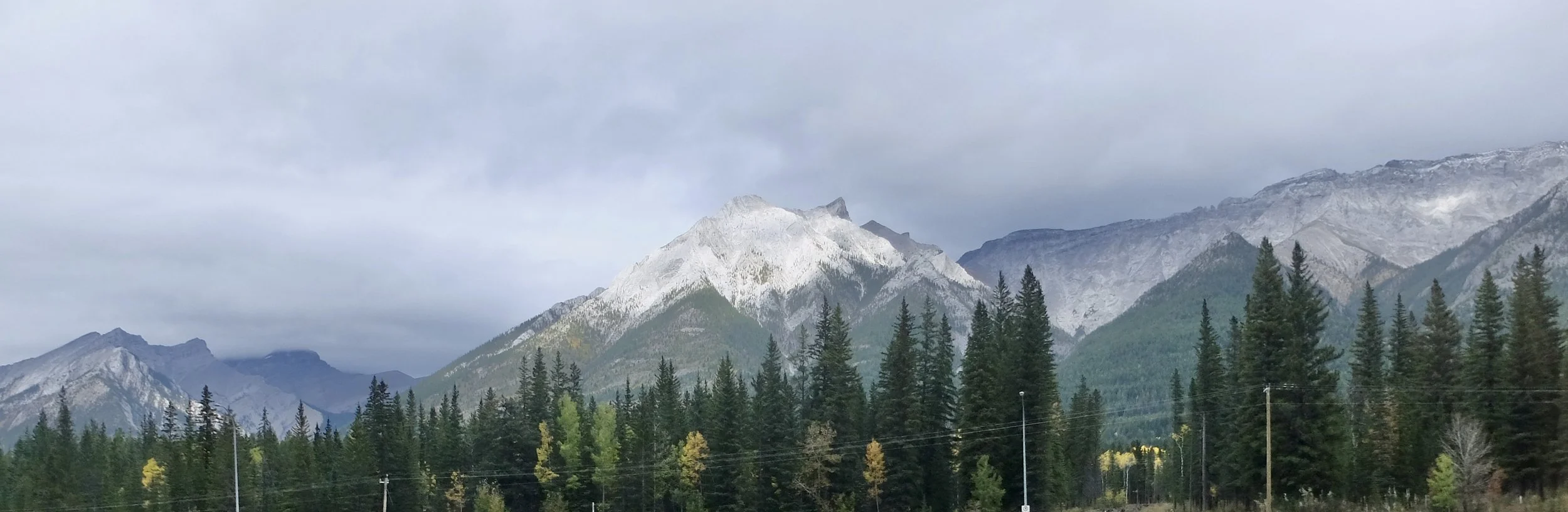
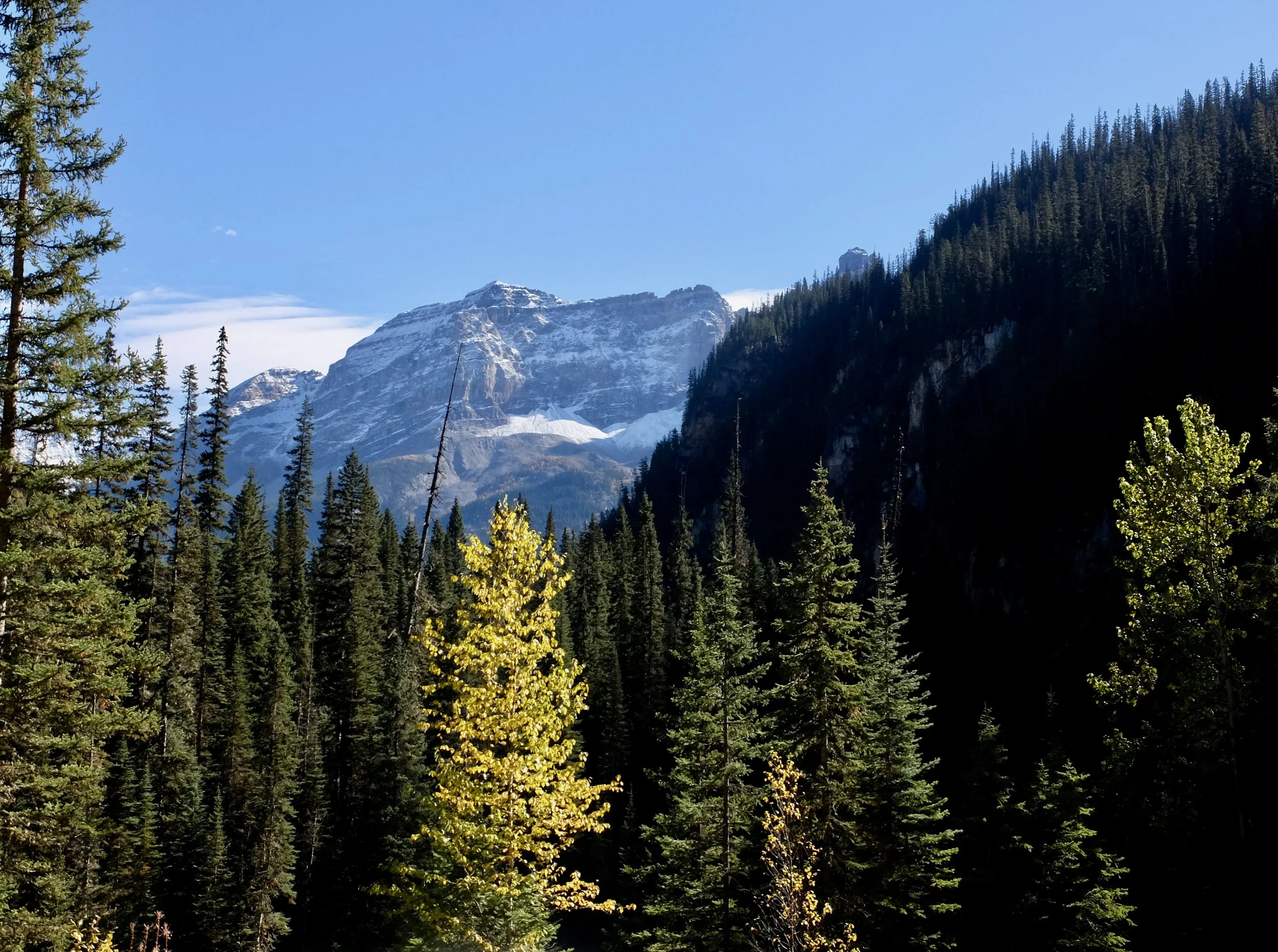
Trans-Canada Highway. First sighting of the Canadian Rockies.
Trans-Canada Highway. The aspens were changing colors.
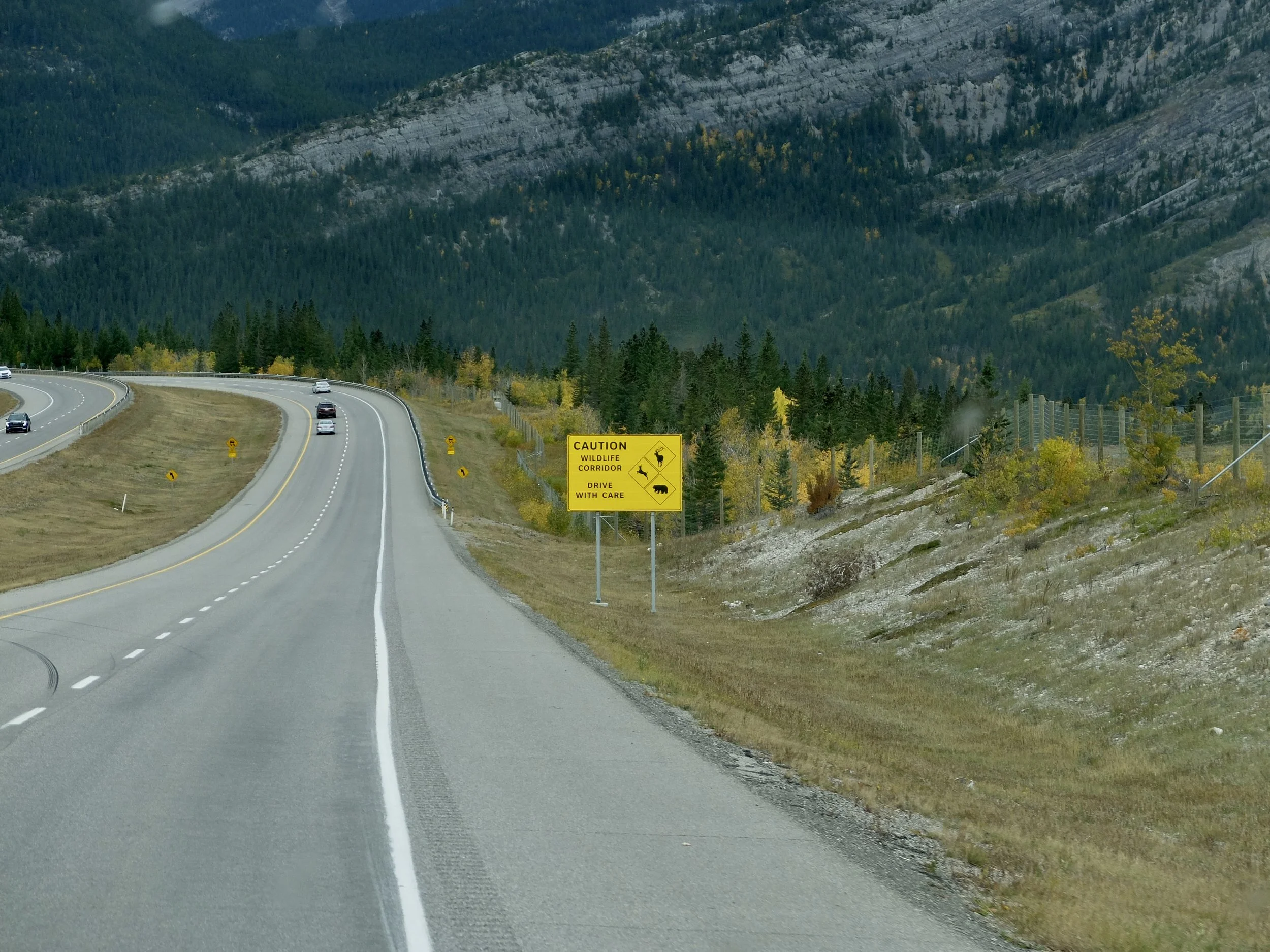
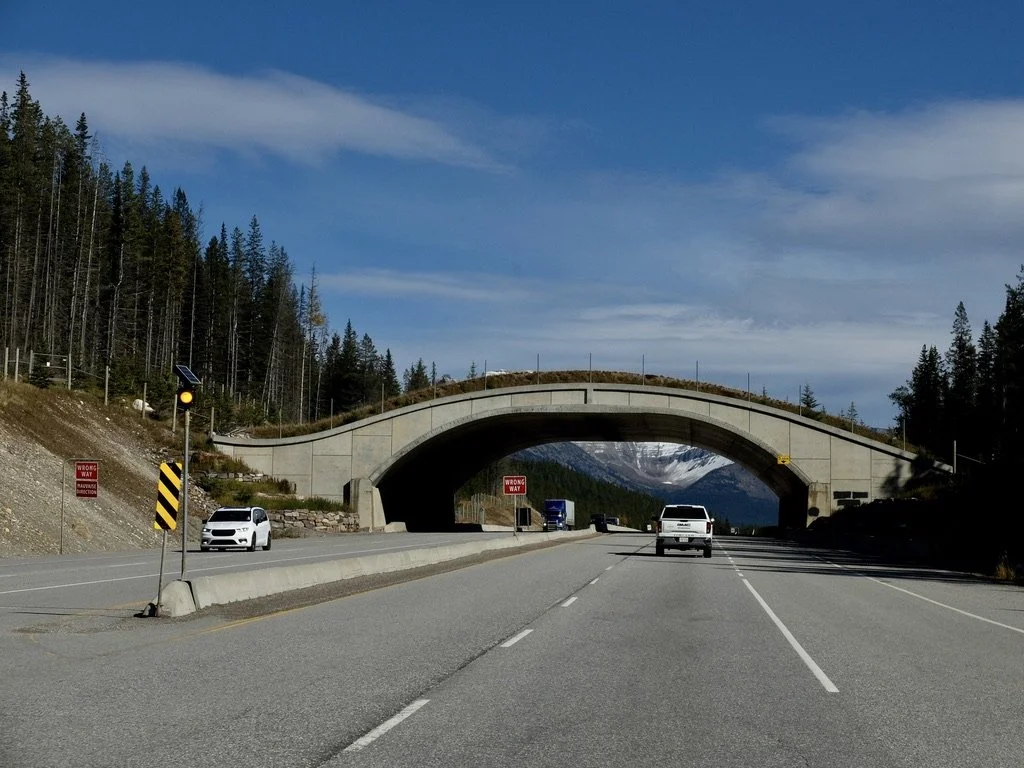
After the opening of the Trans-Canada Highway, motor vehicles were hitting wild animals. A fence was built to keep the animals off the roadway & the numbers of them being killed decreased tremendously.
“Once it became clear that the Trans-Canada Highway in Banff National Park would require an upgrade from two lanes to four, we needed to determine how best to increase the size of the highway while minimizing effects on surrounding wildlife. We also hoped to curb the high rate of wildlife-vehicle collisions on the highway.
To help solve this problem, transportation planners and scientists came up with a two-fold solution:
Install fencing on both sides of the twinned highway to keep large animals from accessing the highway right-of-way.
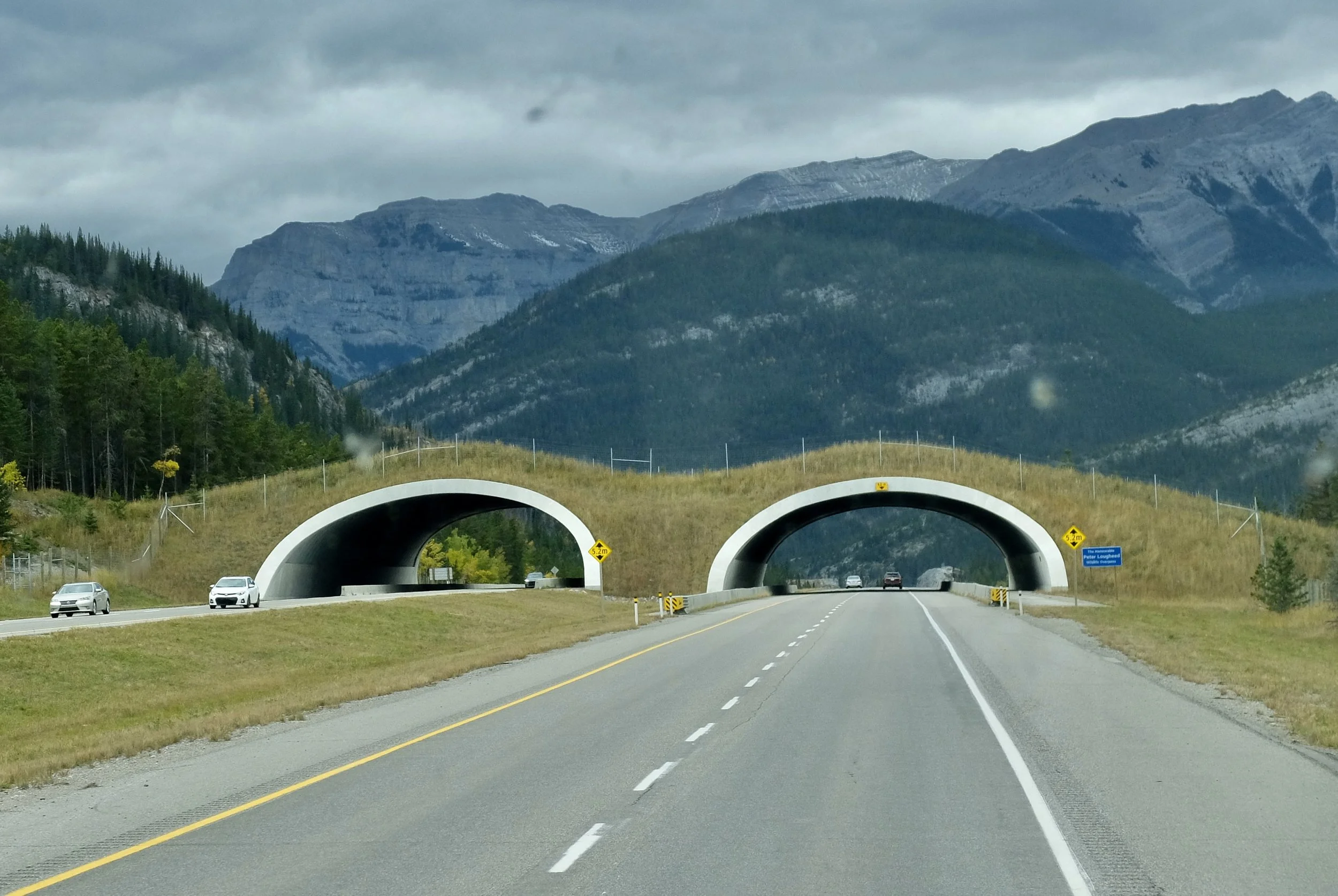
Construct wildlife underpasses and overpasses to connect vital habitats and help sustain healthy wildlife populations by allowing animals to cross under or over the highway.”
“Tracking animal movement at the newly constructed wildlife crossings was made a top priority. Such work has been on-going in the park since 1996; the longest on-going wildlife crossing research and monitoring program in the world.”
The Trans-Canada Highway is a “wildlife corridor.”
Our driver/guide mentioned that the large animals figured out that if they waited at the end of the tunnel at a certain times it woud be easy feeding.
Established in 1885, “Rocky Mountain peaks, glacial lakes, and adventure come together in Banff National Park - Canada’s first national park and the flagship of the nation’s park system. Banff is part of the Canadian Rocky Mountain Parks UNESCO World Heritage Site.”
“Banff National Park is widely regarded as a role model for national parks worldwide because it combines pioneering conservation, UNESCO-recognized natural heritage, and sustainable tourism in a way that has influenced global park management practices.”
“The main commercial centre of the park is the town of Banff, in the Bow River valley.”
“In 1886, Ontario-born pioneer John Brewster followed the Canadian Pacific Railway (CPR) west to Banff, settling with his family and establishing a dairy business The Road Home. The Banff Springs Hotel, built in 1888 and owned by the CPR, became his largest customer. In 1892, John’s sons Bill and Jim Brewster began offering guided fishing and scenic tours for hotel guests The Road Home. By 1900, they formally organized as W. & J. Brewster, Guides and Packers, adding outfitting services and opening the Brewster Trading Store in Banff.” No longer owned by the family, the Brewster name is very common in Alberta.
-
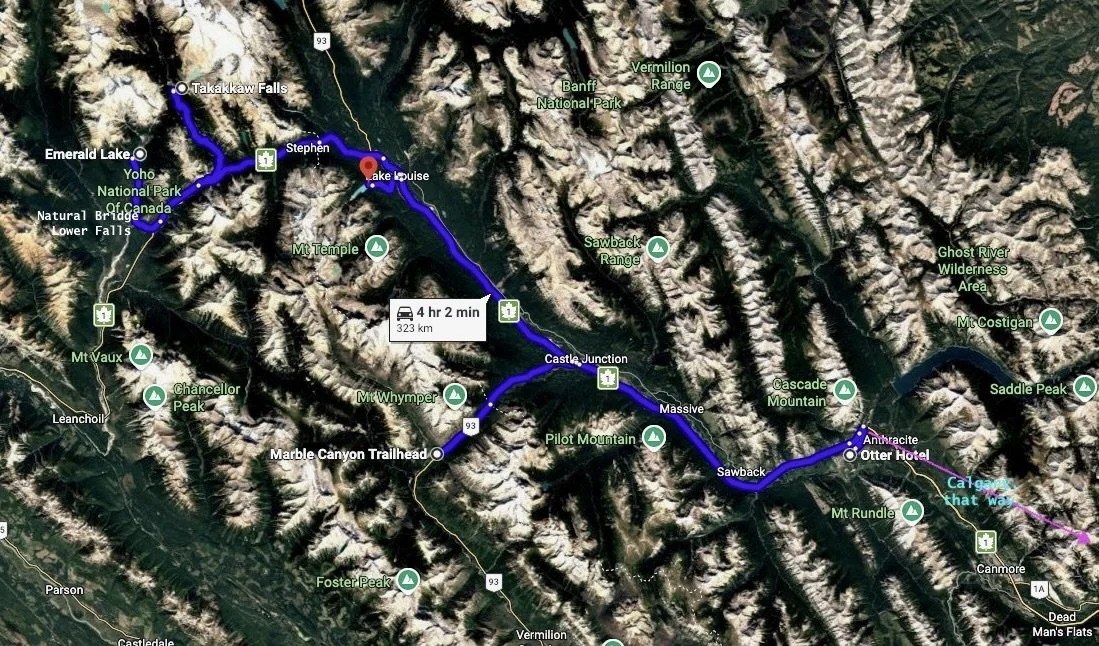
We set out early in a small Radventures tour bus with Gareth, our Tasmanian driver/ guide.
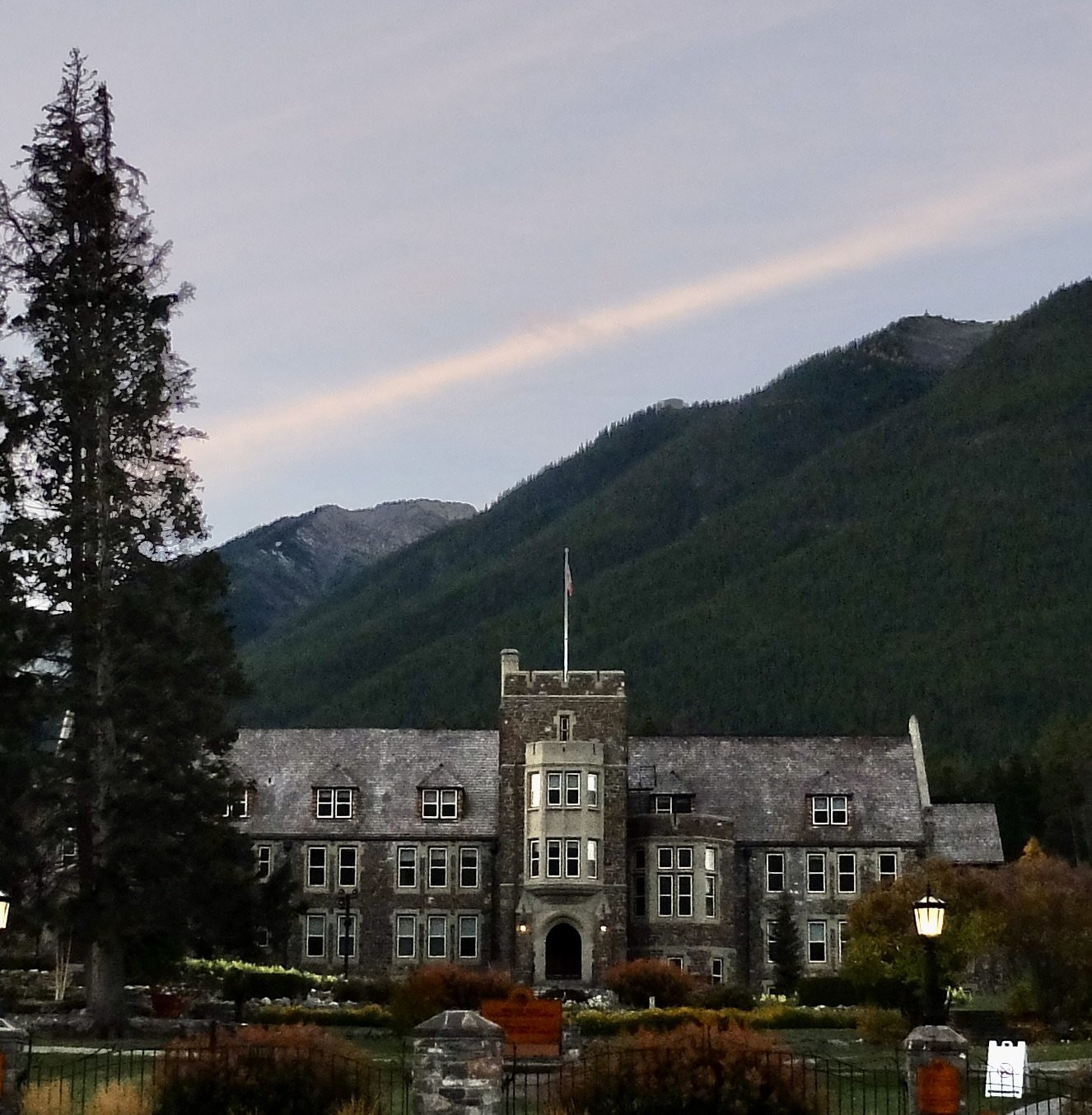
As we left Banff, we passed “The Parks Canada Administration Building is the historic stone structure that overlooks the Cascade of Time Gardens in Banff, Alberta. It is a Recognized Federal Heritage Building and the first administration building of Parks Canada.”
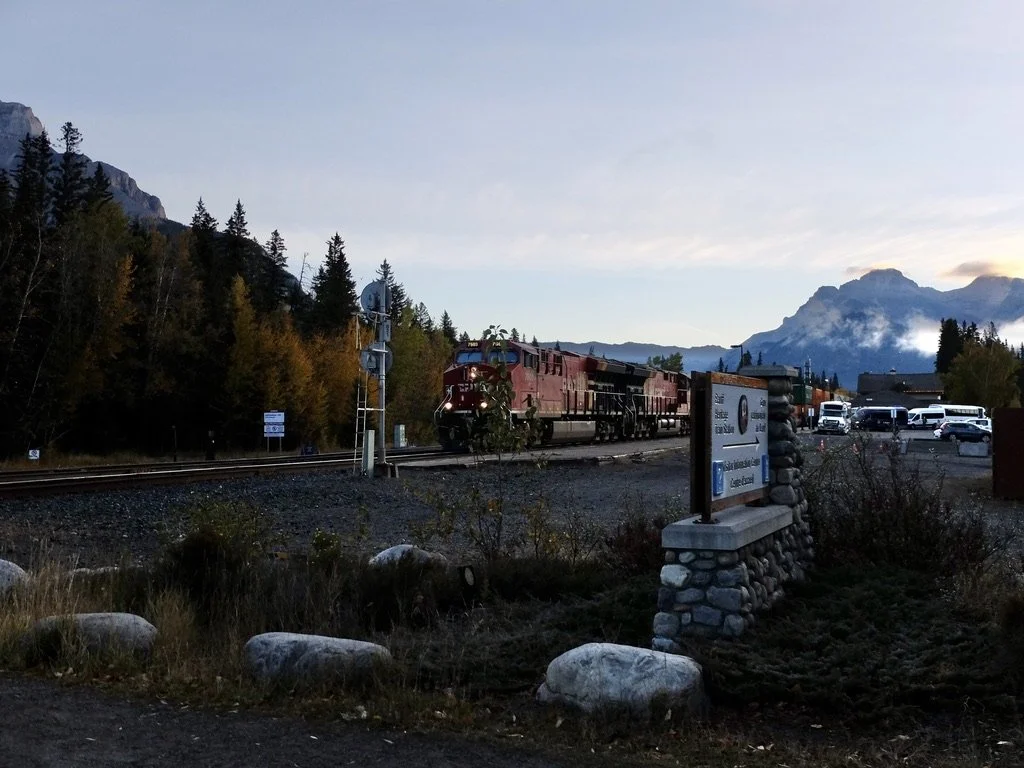
About thirty trains pass through Banff each day. The locals are used to the required traffic stoppages disrupting their travels through town.
“Canada’s rail system is a cornerstone of the nation’s economy, trade, and connectivity, playing a critical role in moving goods, people, and resources across its vast geography.”
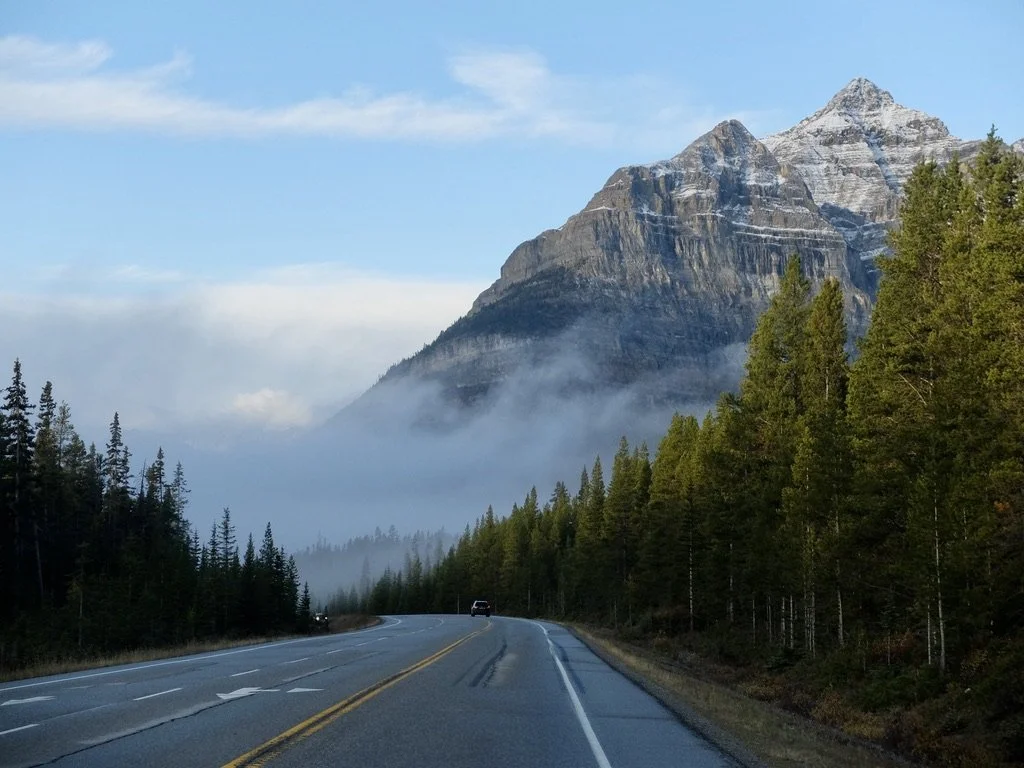
Highway 93 to Marble Canyon in Kootenay National Park, British Columbia (B.C.).
-
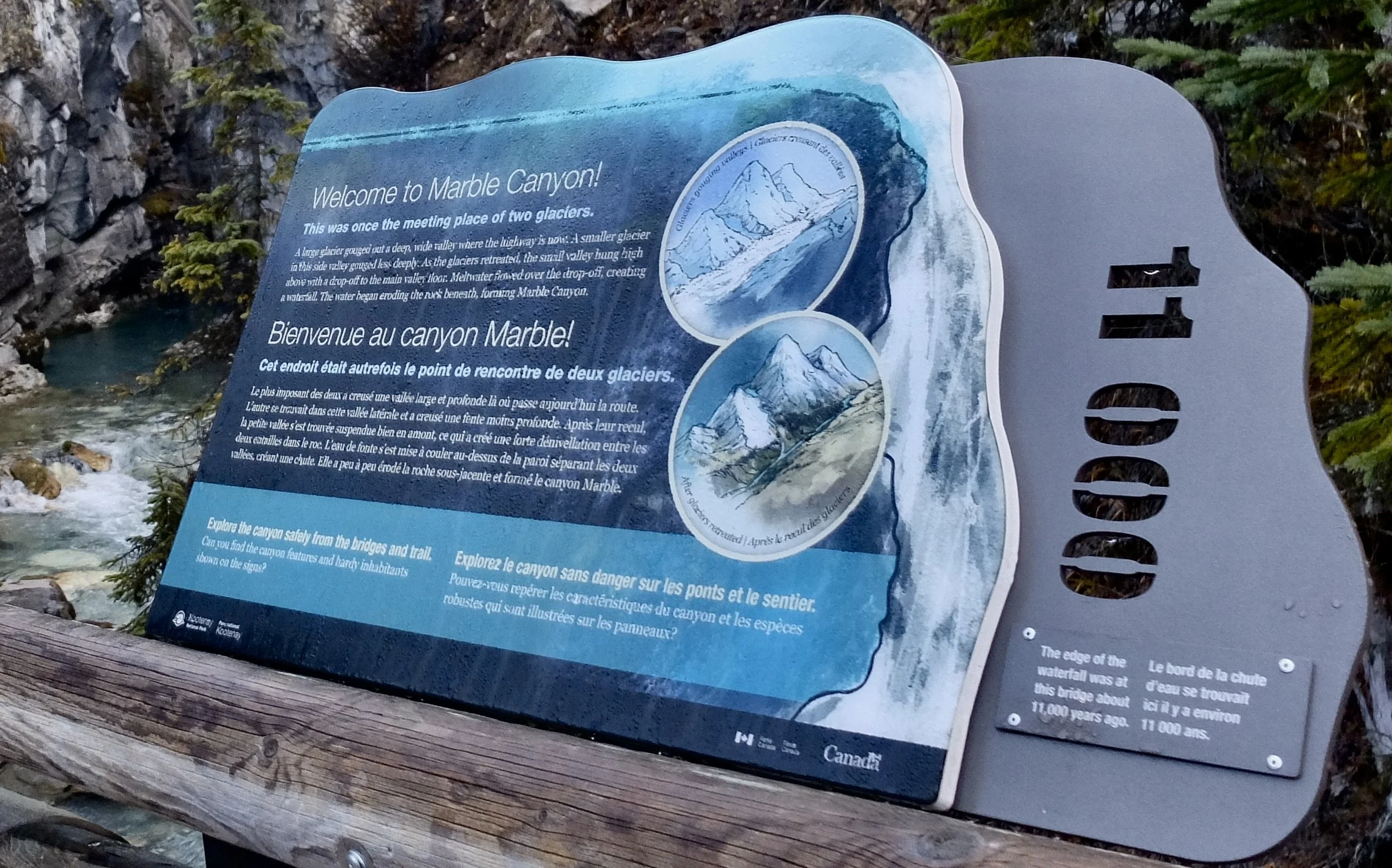
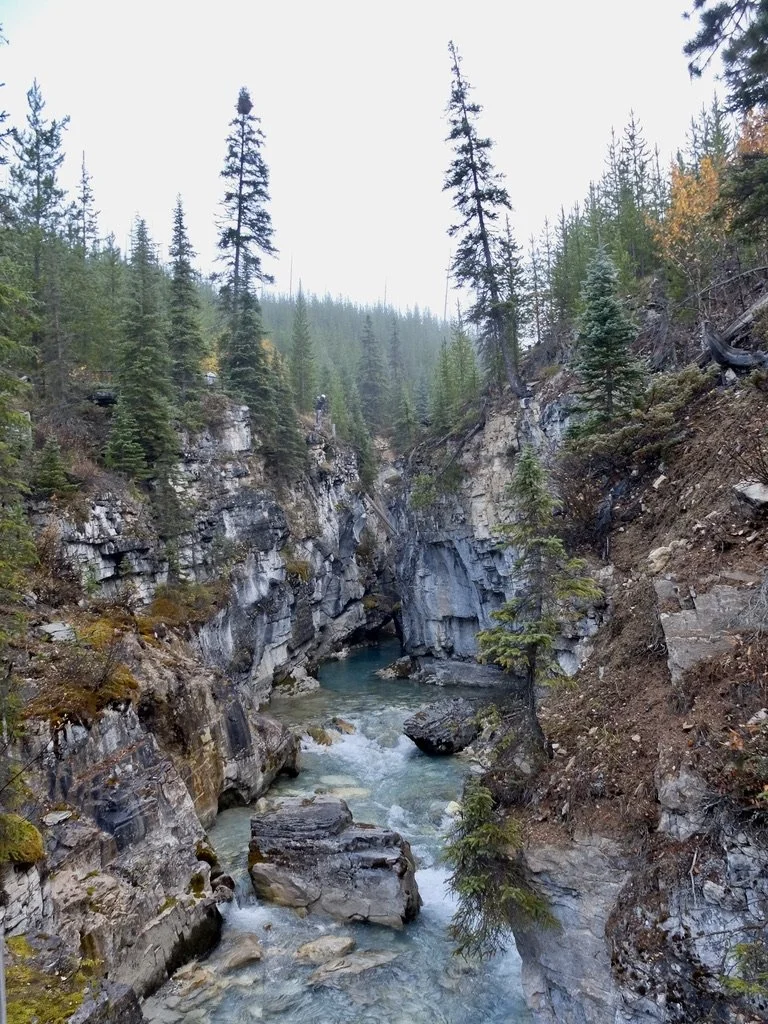
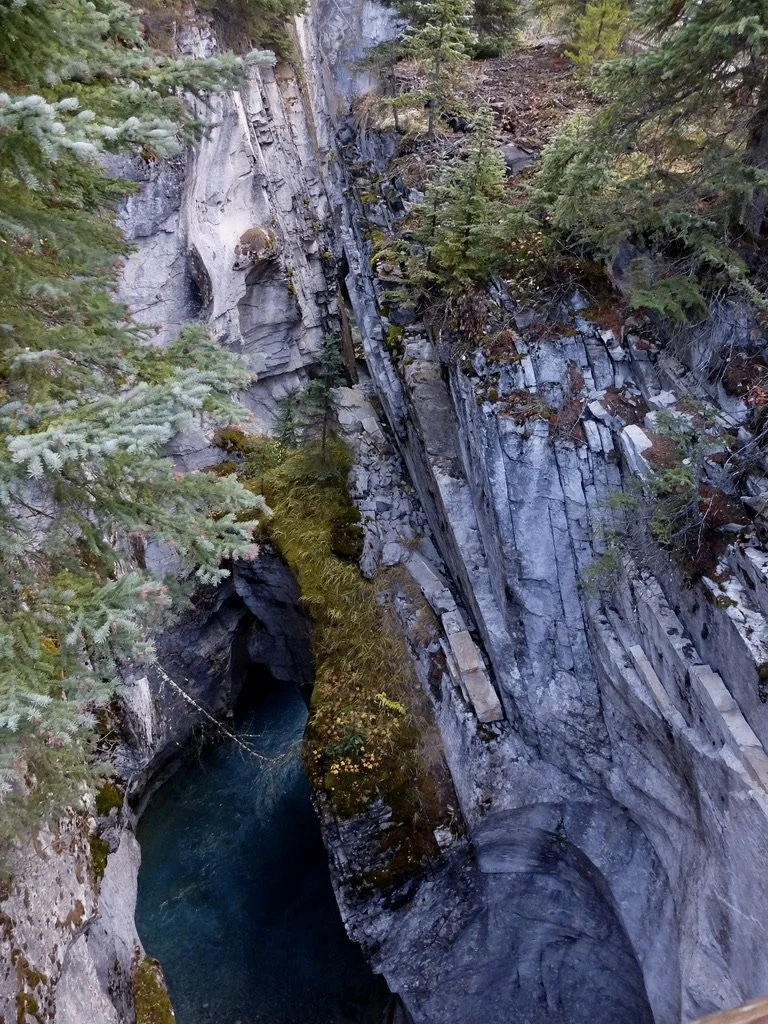
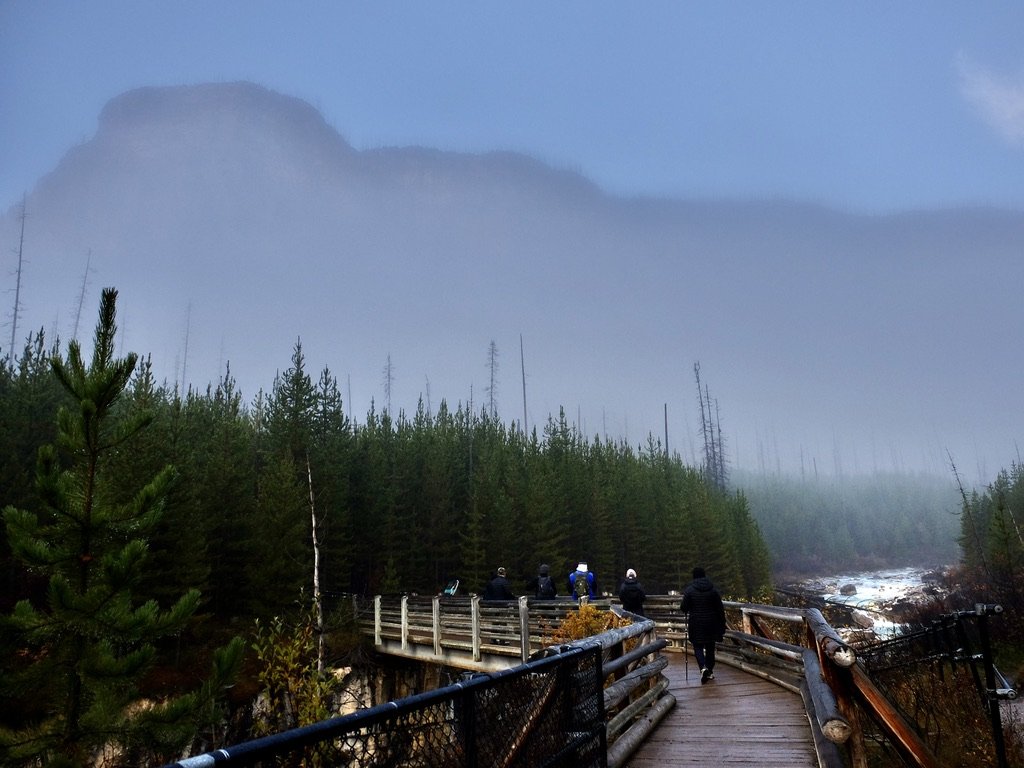
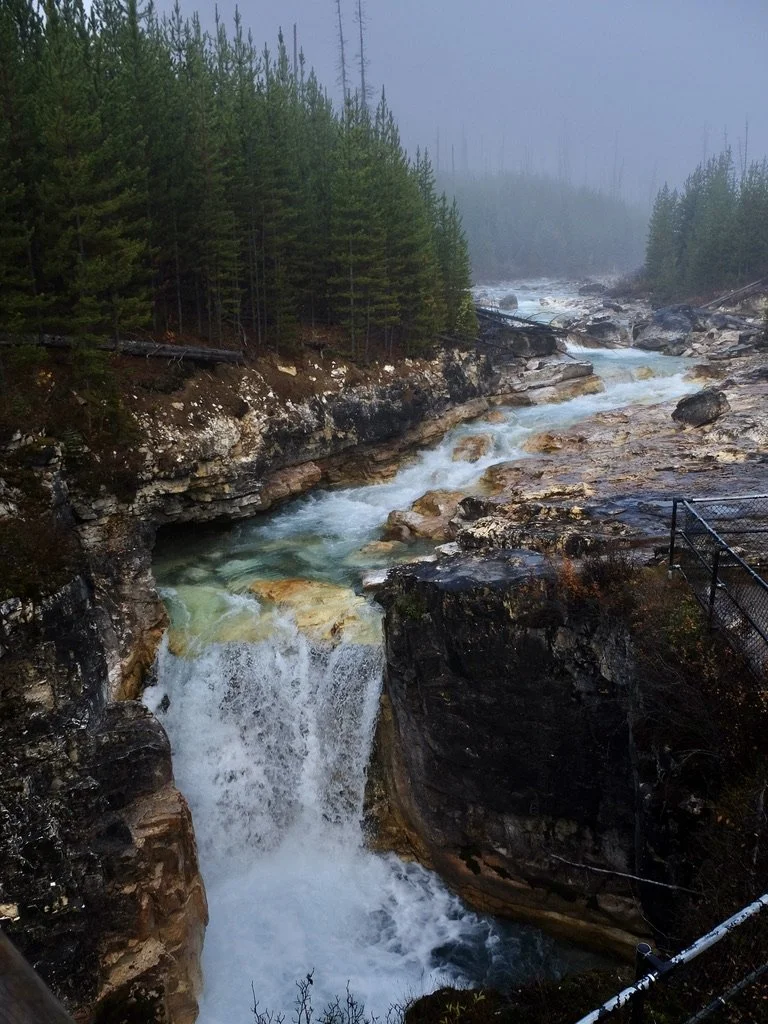
“…narrow limestone gorge carved by Tokumm Creek into Paleozoic microcrystalline limestone. Despite its name, the rock is limestone, not metamorphic marble; the name comes from the smooth, polished appearance of the walls.”
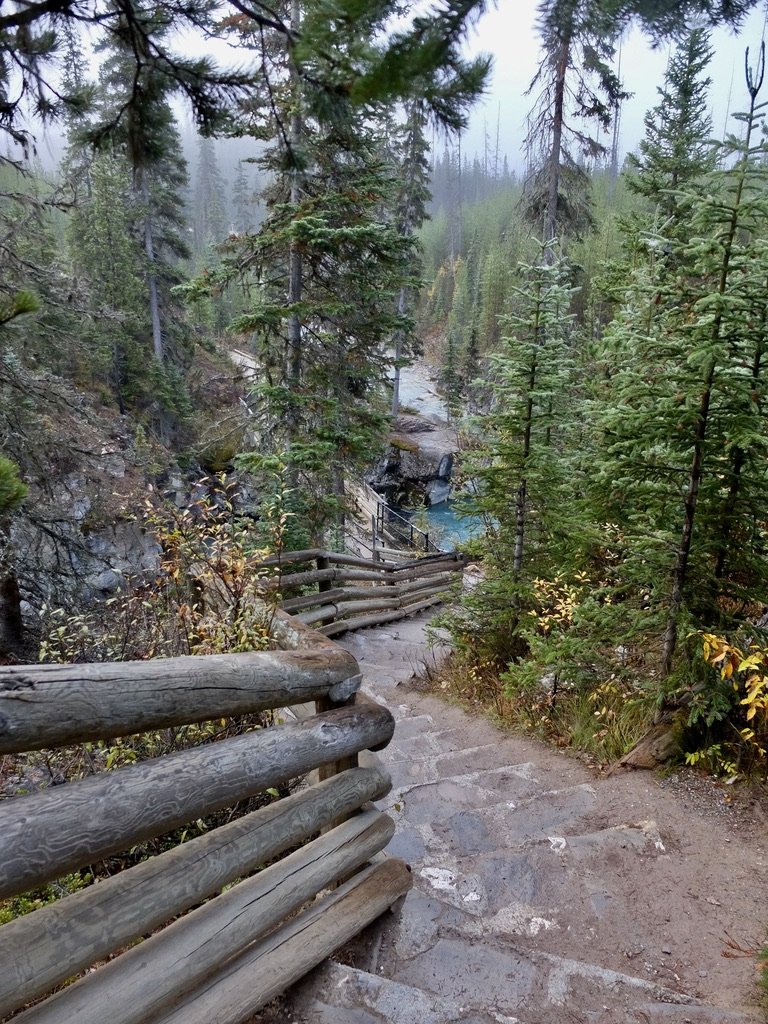
Gareth had a selection of walking sticks for us. We needed them on this terrain.
“The bedrock is microcrystalline limestone from ancient marine deposits of the Paleozoic era. This limestone is distinct from the surrounding granitic terrain and is responsible for the canyon’s sheer, chalky-white cliffs and slot-like profile. The canyon’s name is misleading — it is not made of marble (metamorphic rock) but of sedimentary limestone.”
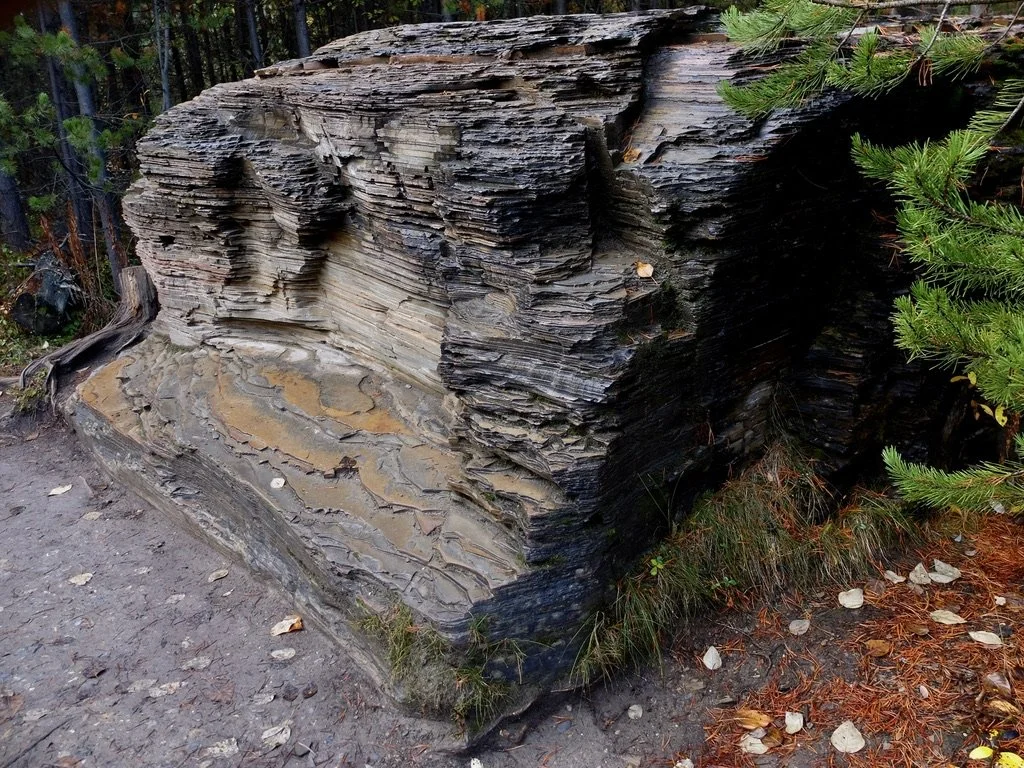
Sadly left behind, but lucky for us, by a glacier.
-
-
Road to Natural Bridge.
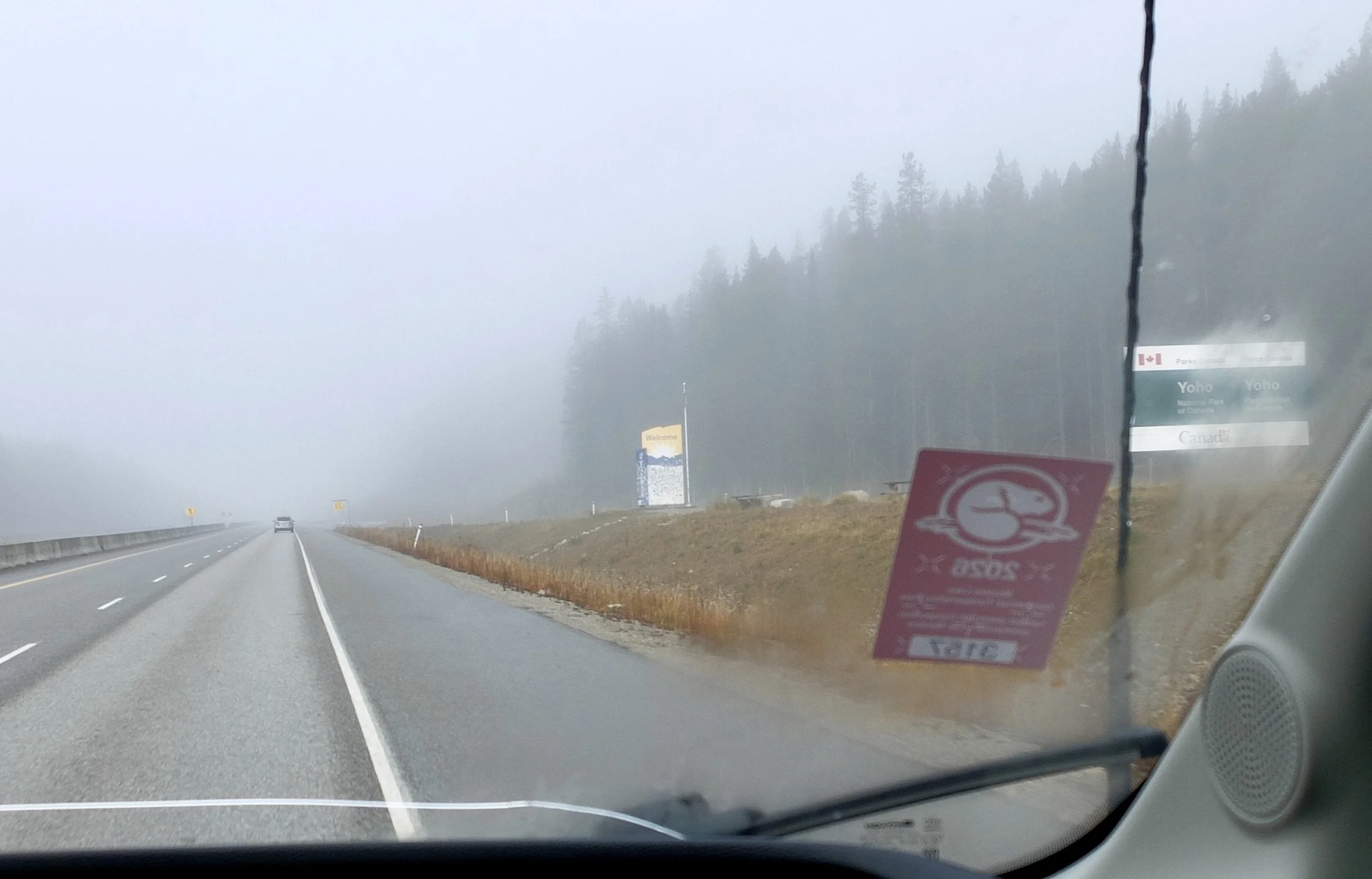
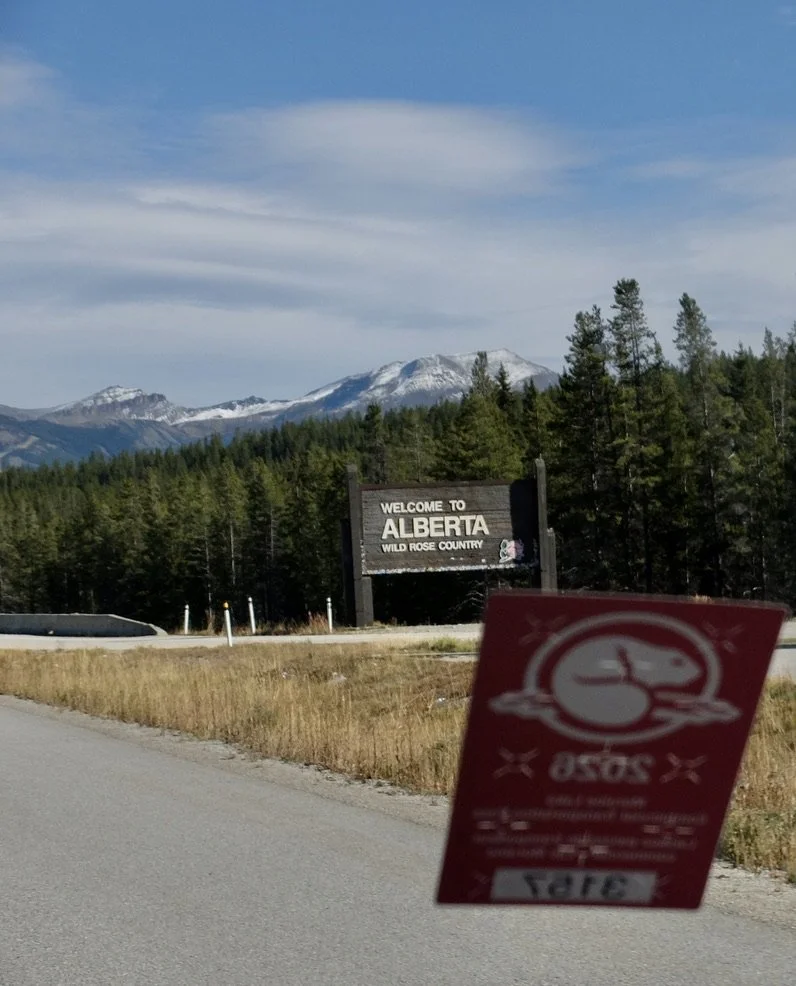
On the registration decal is the beaver, the national animal of Canada, a symbol of Canadian sovereignty.
Note the cracked windshield. More on that in another blog.
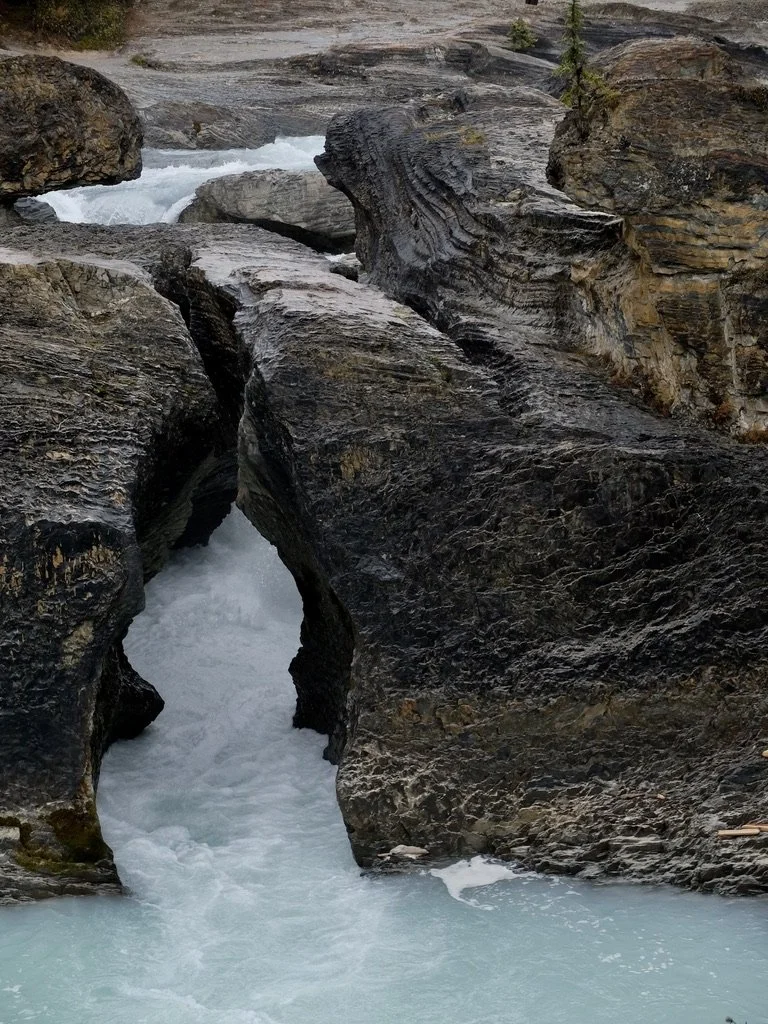
In Yoho Nat’l Park, B.C., “Natural Bridge is a dramatic rock formation created by thousands of years of erosion by the Kicking Horse River. Softer rock beneath a harder limestone band eroded more quickly, eventually diverting the river under the rock and forming the ‘bridge.’”
Emerald Lake - Yoho Nat'l Park, Alberta.
Emerald Lake - Yoho Nat'l Park, Alberta.
Emerald Lake - Yoho Nat'l Park, Alberta.
Emerald Lake - Yoho Nat'l Park, Alberta.
Yoho Valley Road to Takakkawa Falls.
Takakkawa Falls.
Yoho Valley Road back to Trans Canadian Highway.
Trembling Aspen. “The distinctive triangular leaves of this slender tree shimmer & quiver in the breeze…”
Trans Canadian Highway return to Banff.
Wildlife overpass on Trans Canadian Highway return to Banff.
Trans Canadian Highway return to Banff.
ALBERTA - Wild Rose Country “…official provincial flower, the wild rose (Rosa acicularis), symbolizes the province’s natural beauty, resilience, and pioneering spirit.”
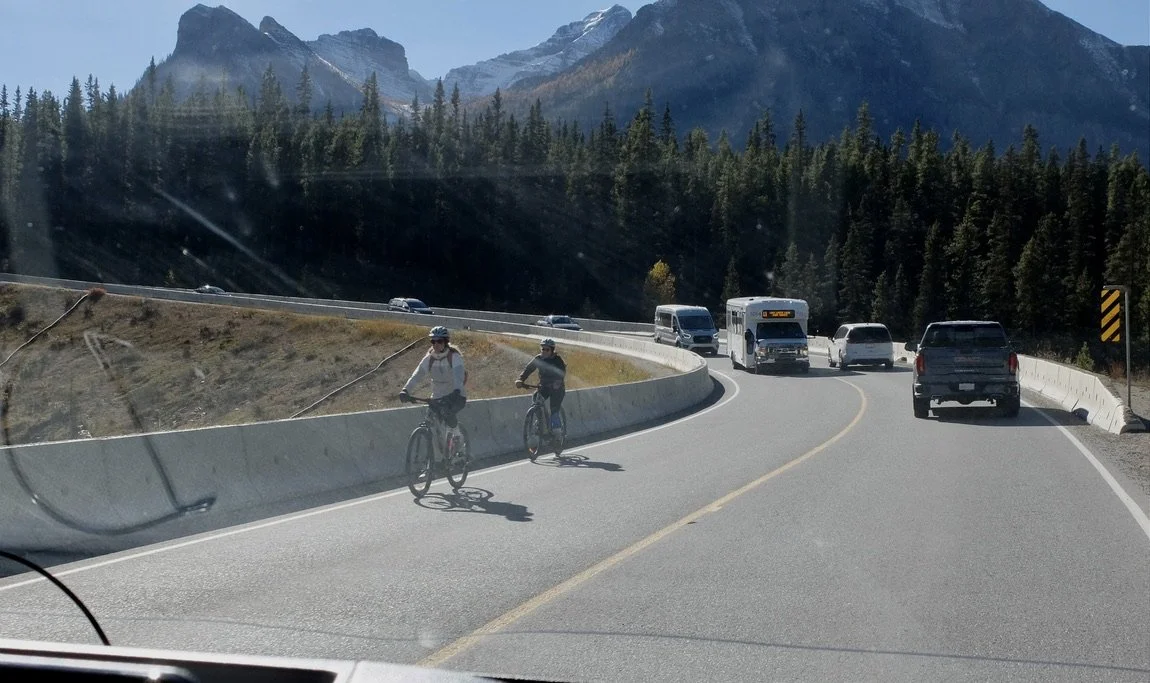
OMG, no shoulder, biking uphill, tourists in RVs; crazy!
Highway to Banff.
Wildlife overpass on Trans Canadian Highway return to Banff.
Trans Canadian Highway return to Banff.
We had a day to walk around & explore the Town of Banff.
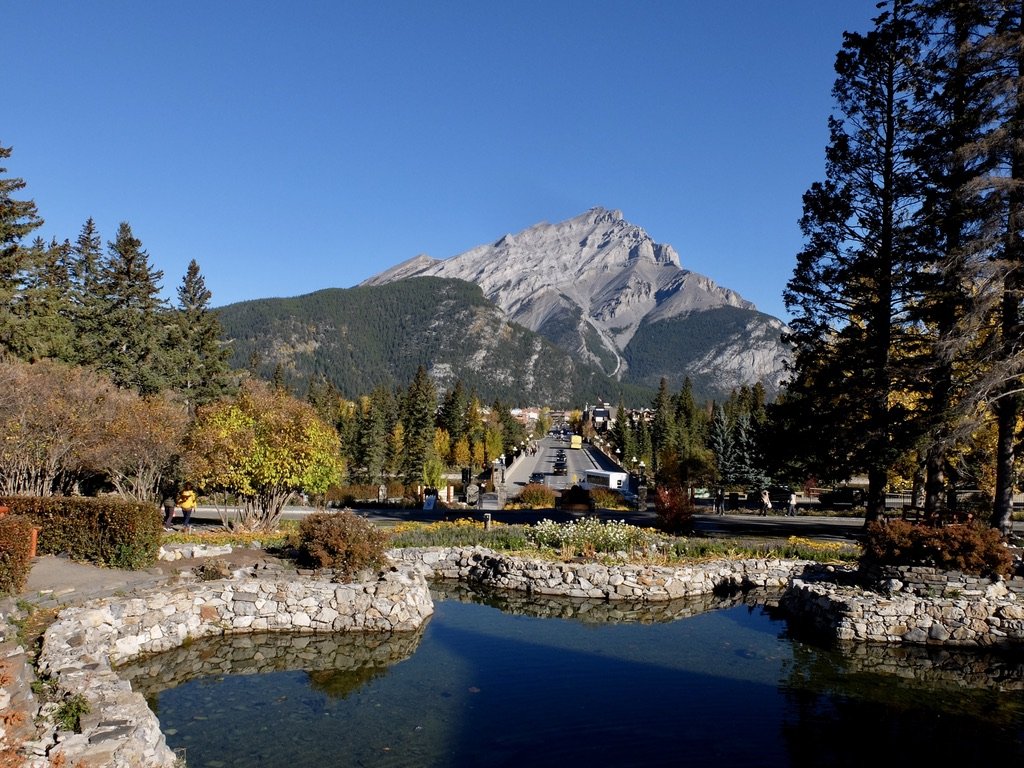
Cascade of Time Gardens.
The iconic view of Banff Ave., "The Strip,” looking down from Cascade of Time Gardens.
View from the Cascade of Time Gardens.
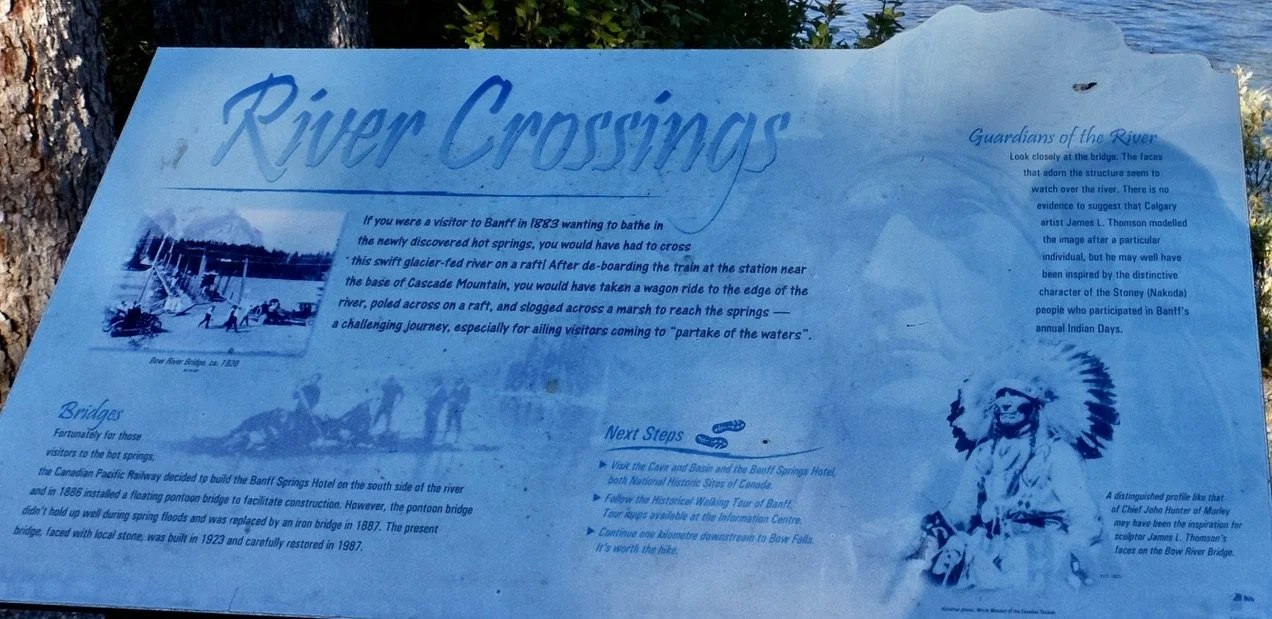
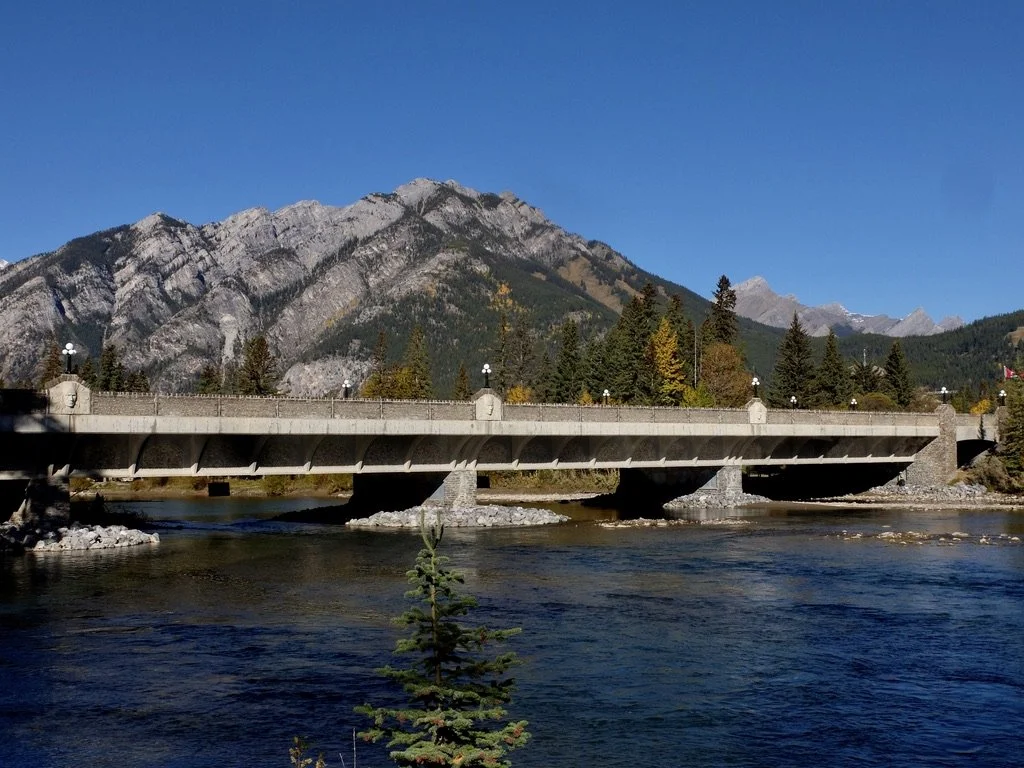
Looking at the Bow River Bridge.
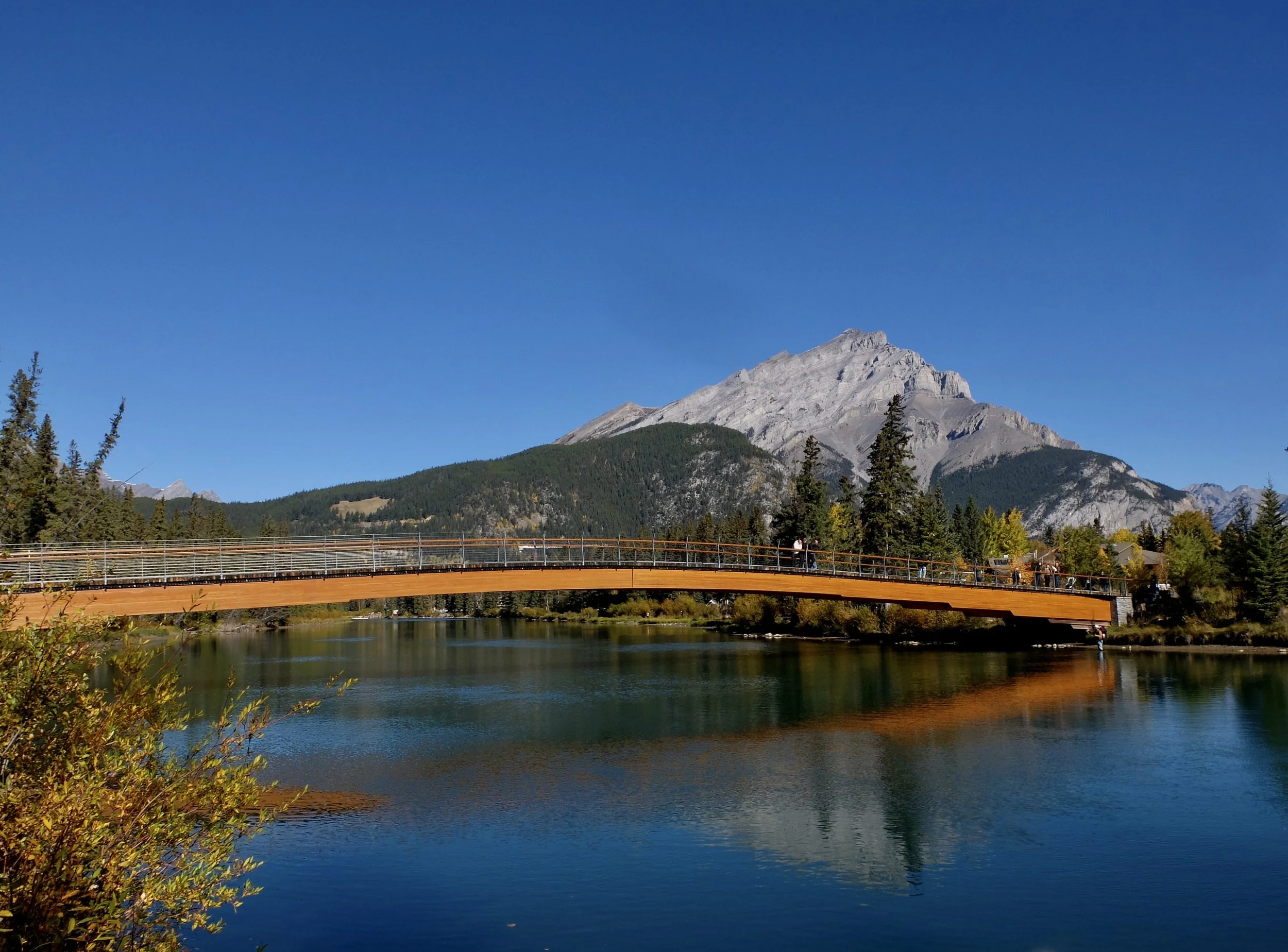
Banff’s Bow River Bridge. "The river’s name, Bow, originated from the reeds growing along its banks, which the First Nations used to make bows."
On the path along the Bow River to the Bow River Falls.
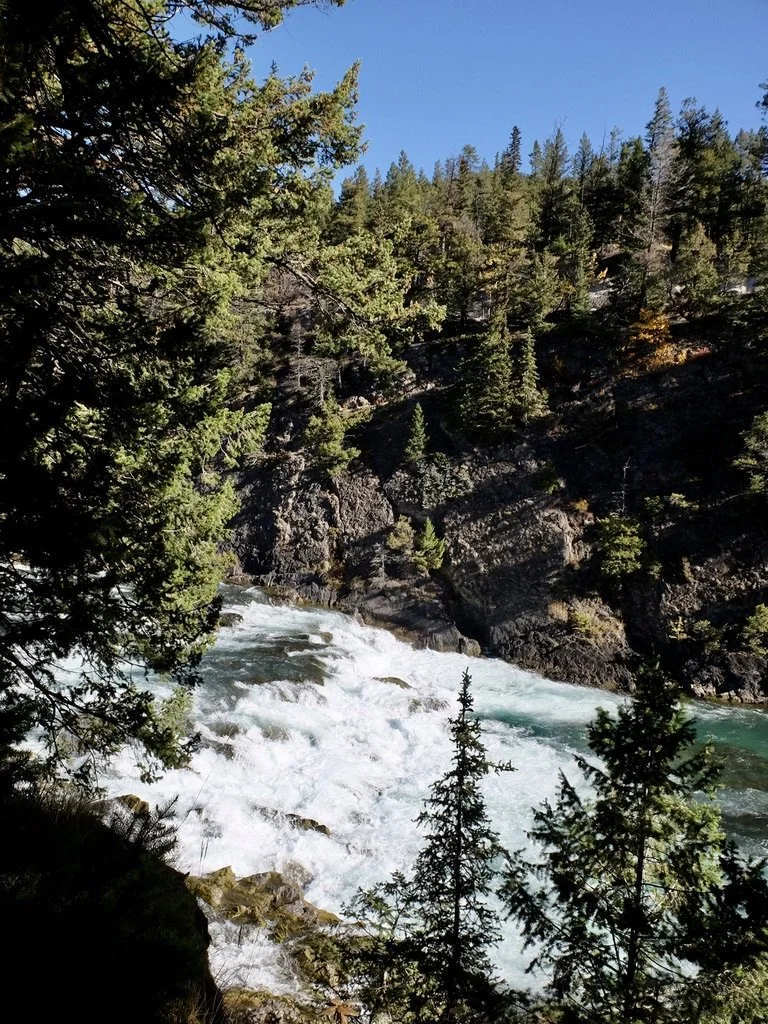
Bow River Falls fed by Bow Glacier Falls.
The 2022 Nancy Pauw Bridge over the Bow River.
Along Banff Ave. in downtown Banff.
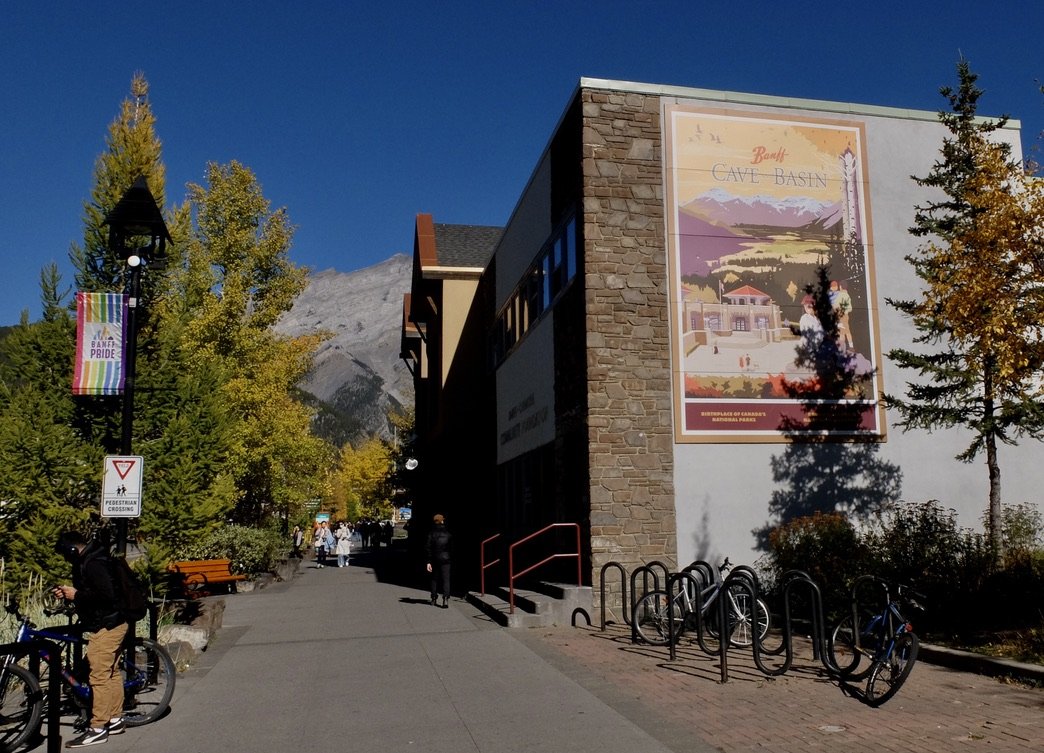
Sign for Cave and Basin National Historic Site along Banff Ave. in downtown Banff.
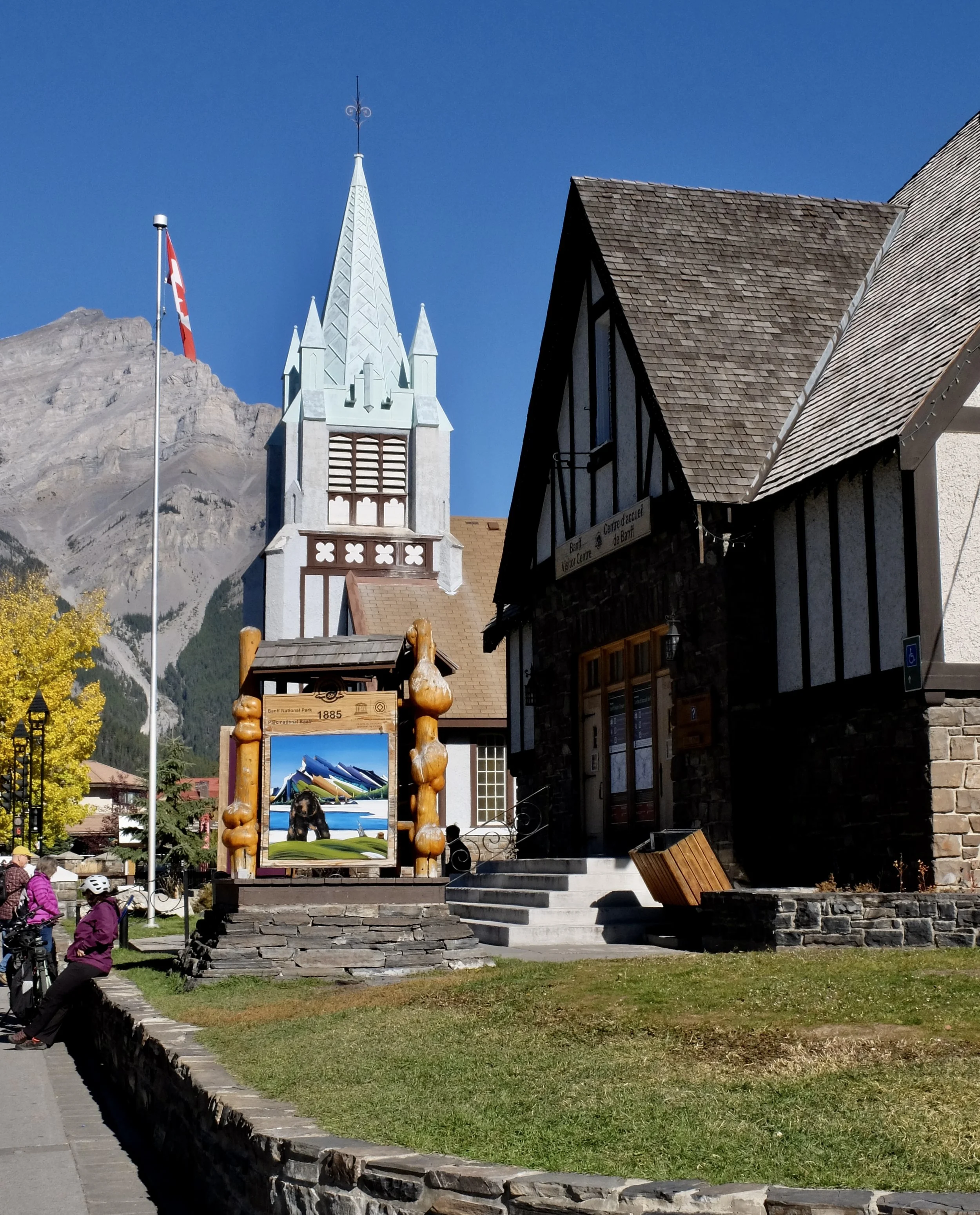
Banff Visitor Centre (“…which is a recognized federal heritage building constructed by the Banff School District between 1939 and 1940”) & circa 1930 St. Paul's Presbyterian Church along Banff Ave. in downtown Banff.
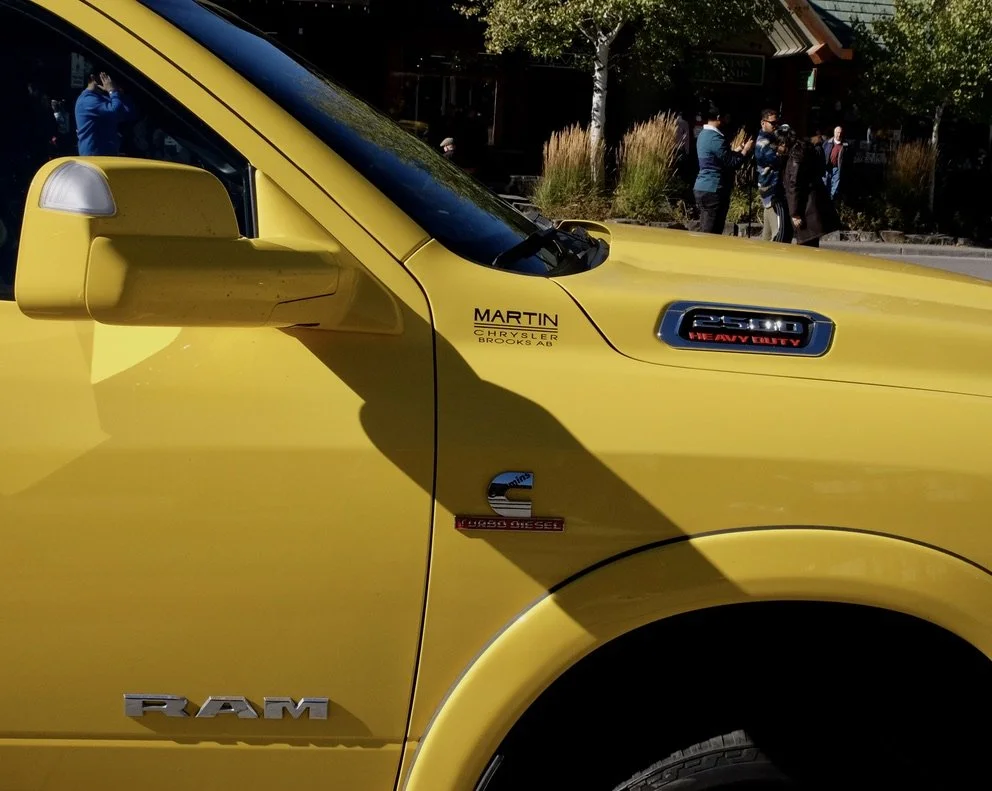
My side hustle.
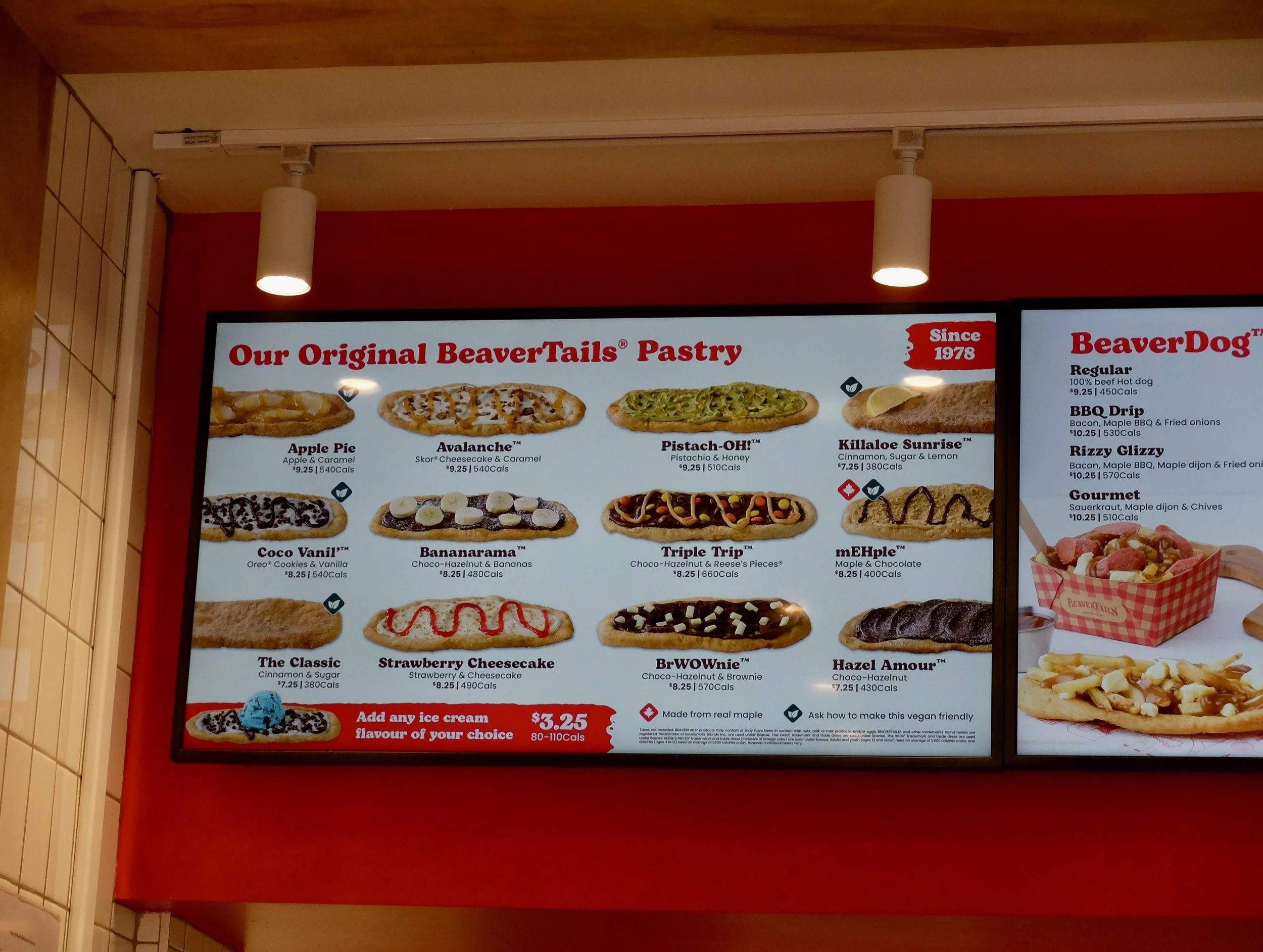
Along Banff Ave. there were two of these shops. If the line was too long at the 1st, we were told to go to this one. There was no line but we just looked…
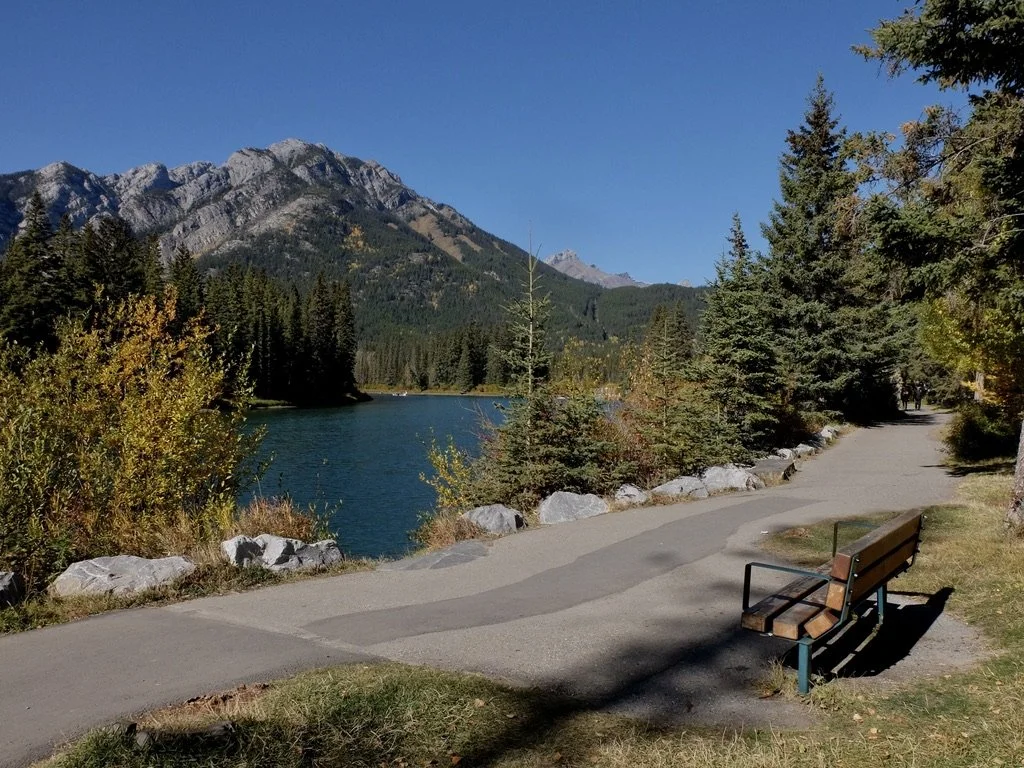
The Bow River Commonwealth Sentier Walkway.
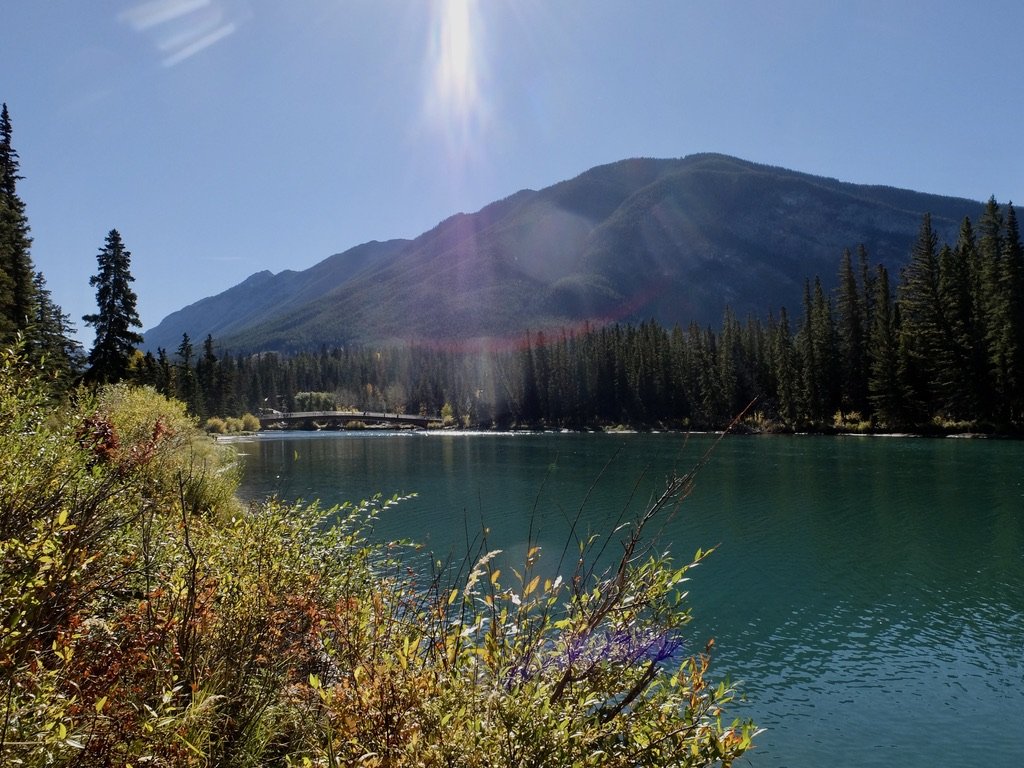
The Bow River Commonwealth Sentier Walkway with a view back of the Nancy Pauw Bridge.
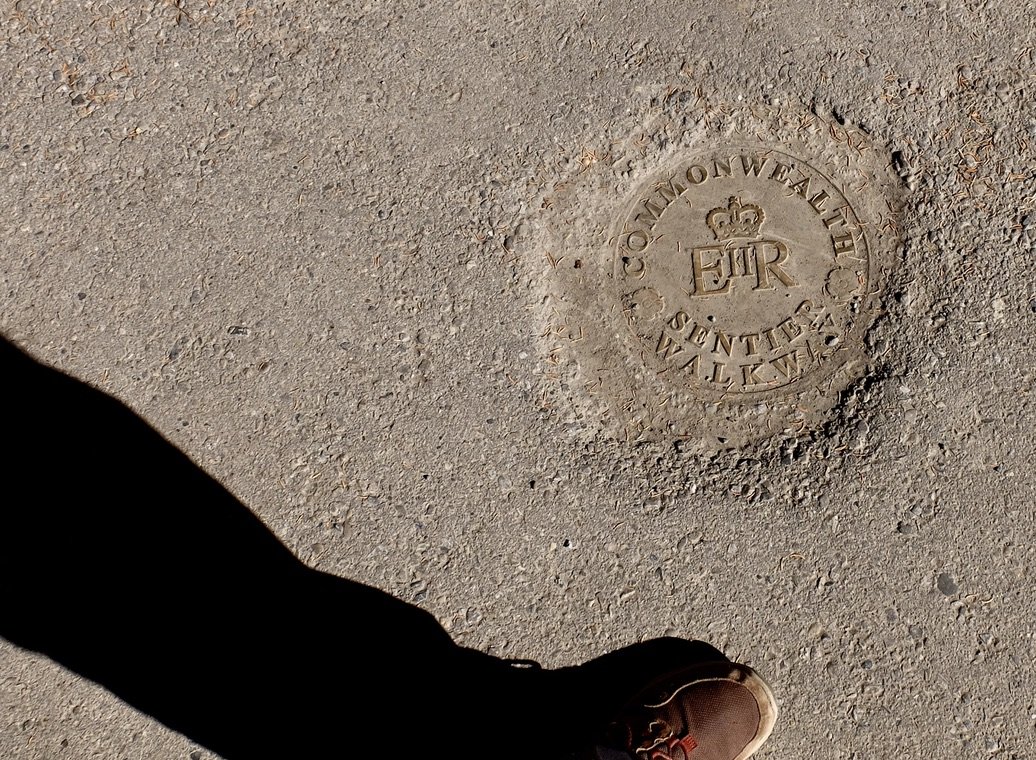
The 2012 "The Commonwealth Walkway initiative aims to create walkways in towns and cities around the world to preserve and protect the physical and mental health of people, advance their education in relation to natural and cultural heritage and promote conservation, protection and improvement of the historical and natural environment."
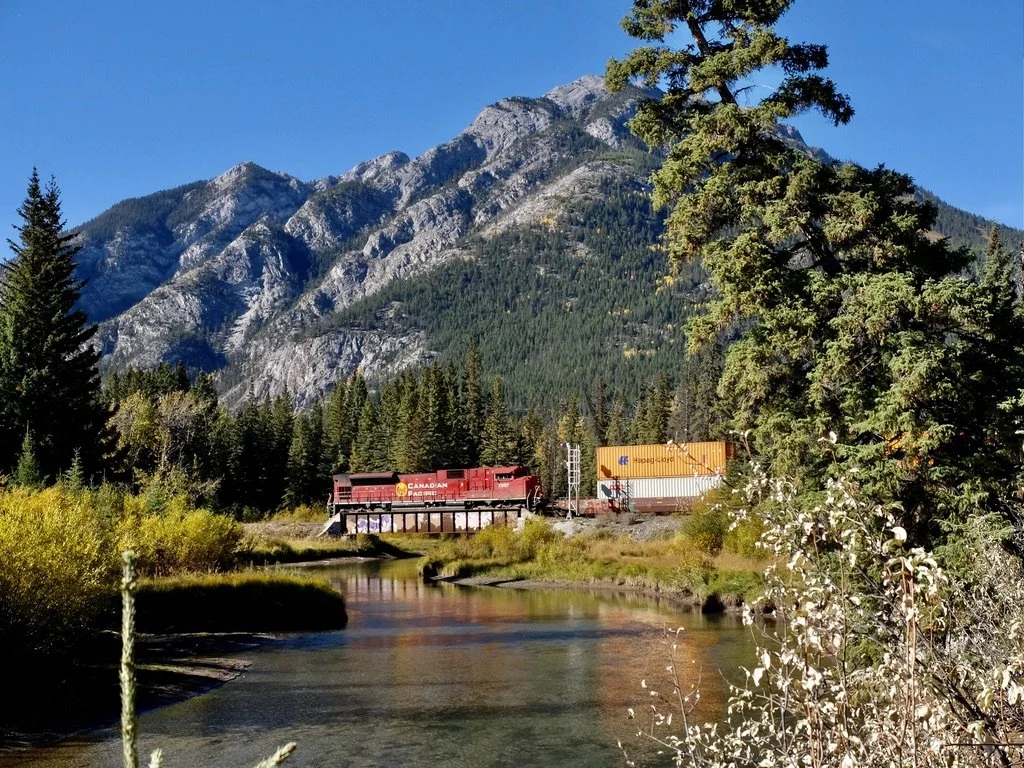
Crossing the Bow river one of the many trains to pass through Banff each day.
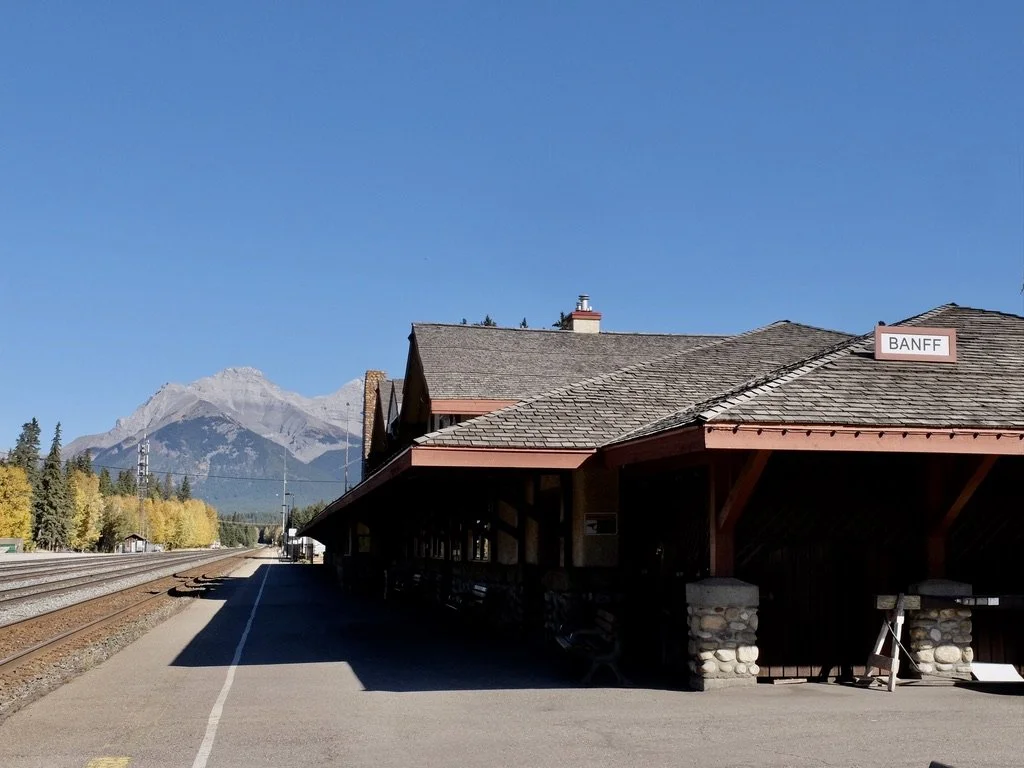
“The Banff Train Station, located at 327 Railway Ave, is a historic landmark built in 1910 by the Canadian Pacific Railway.” It is an Eco-Transit Hub.
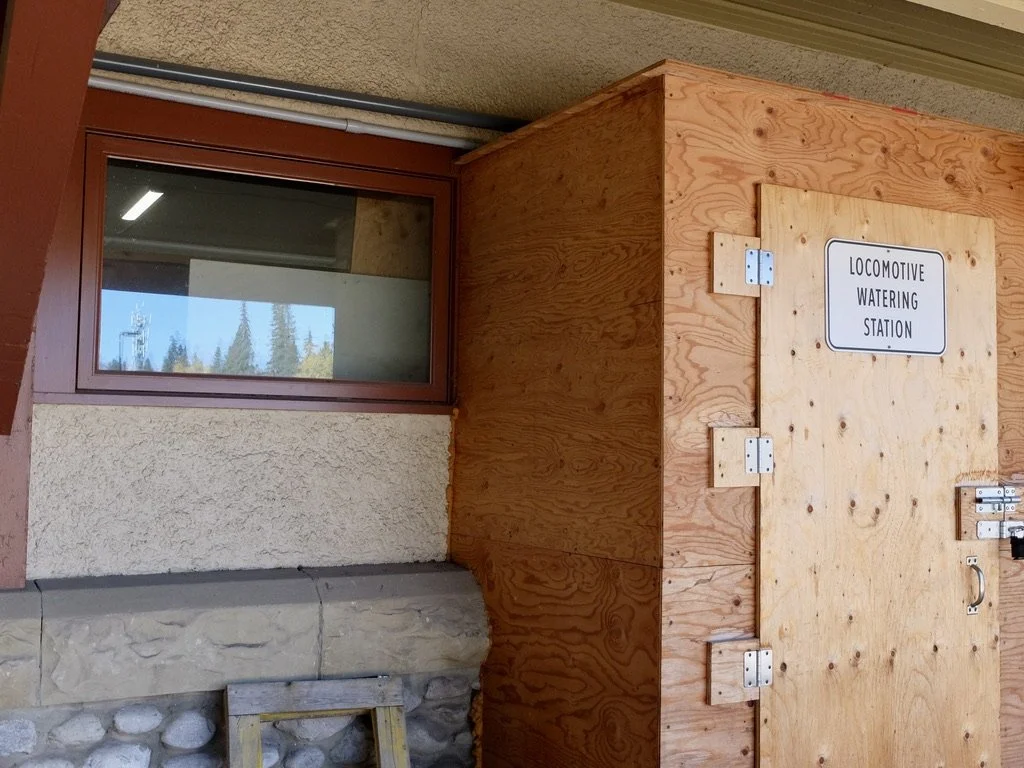
The Banff Train Station.
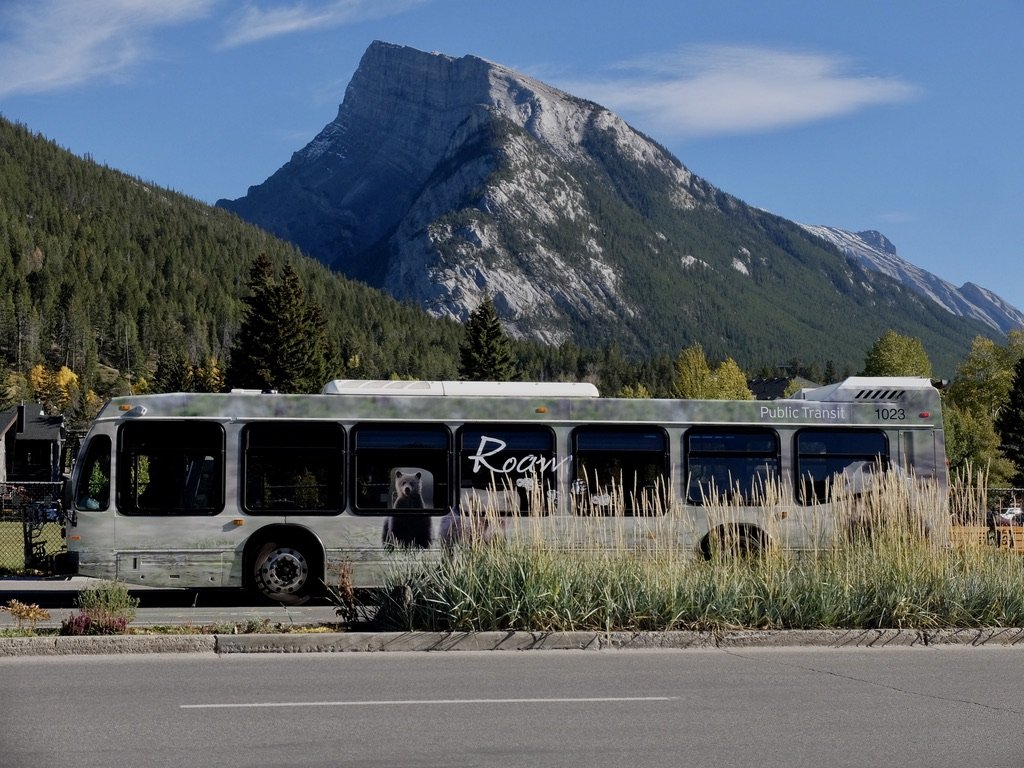
"Roam (Public) Transit offers reliable, convenient bus service across Banff, Canmore and Lake Louise." It goes to other destinations in the high season.
At the Otter Hotel we were given passes that allowed us to take the bus around Banff & to the Banff Gondola.
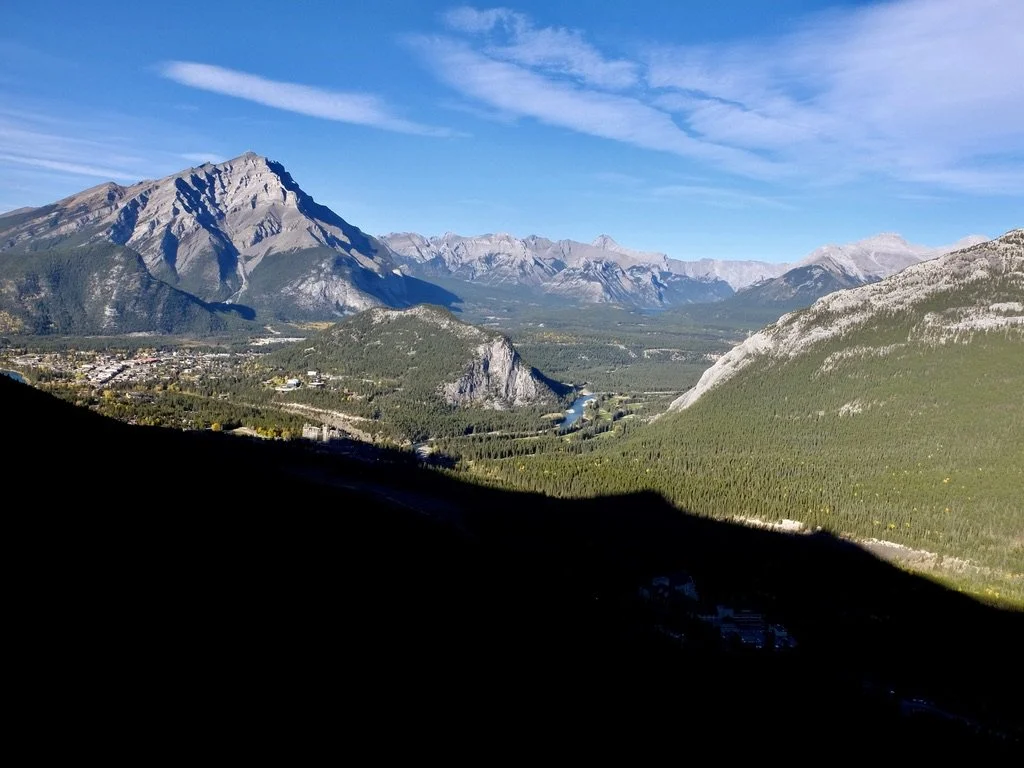
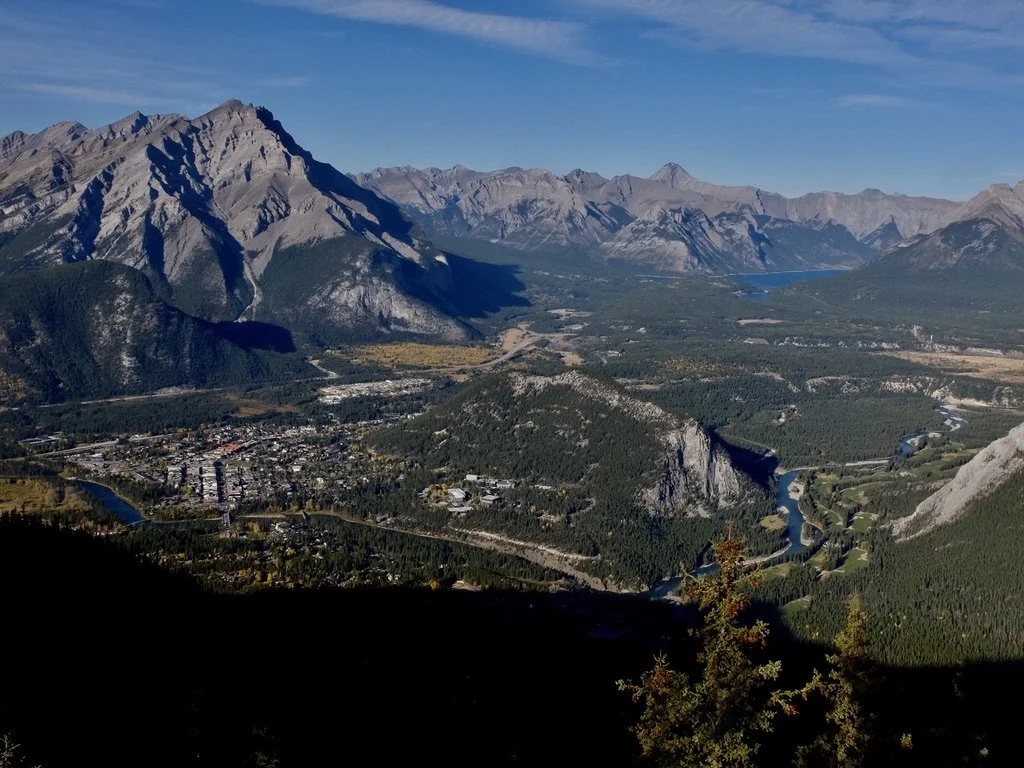
Ascending Sufphur Mountain Banff & Bow Valley from Banff gondola.
Ascending Sufphur Mountain Banff & Bow Valley from Banff Gondola.
We would have preferred to take a boat excursion on Moraine Lake.
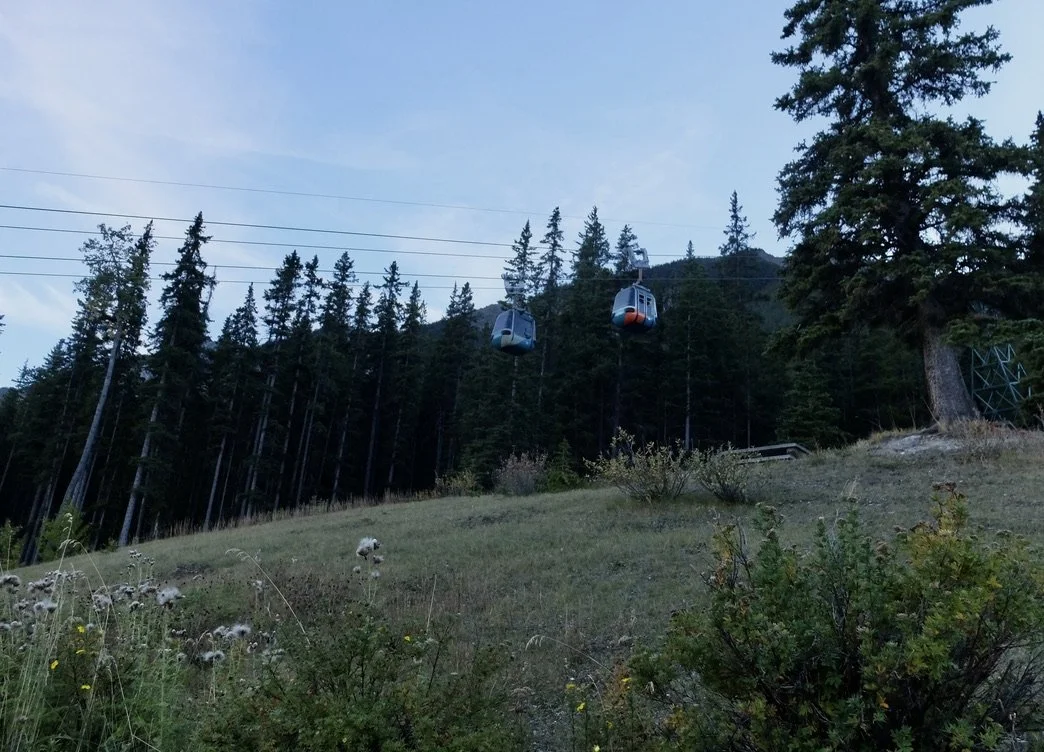
Banff gondolas.
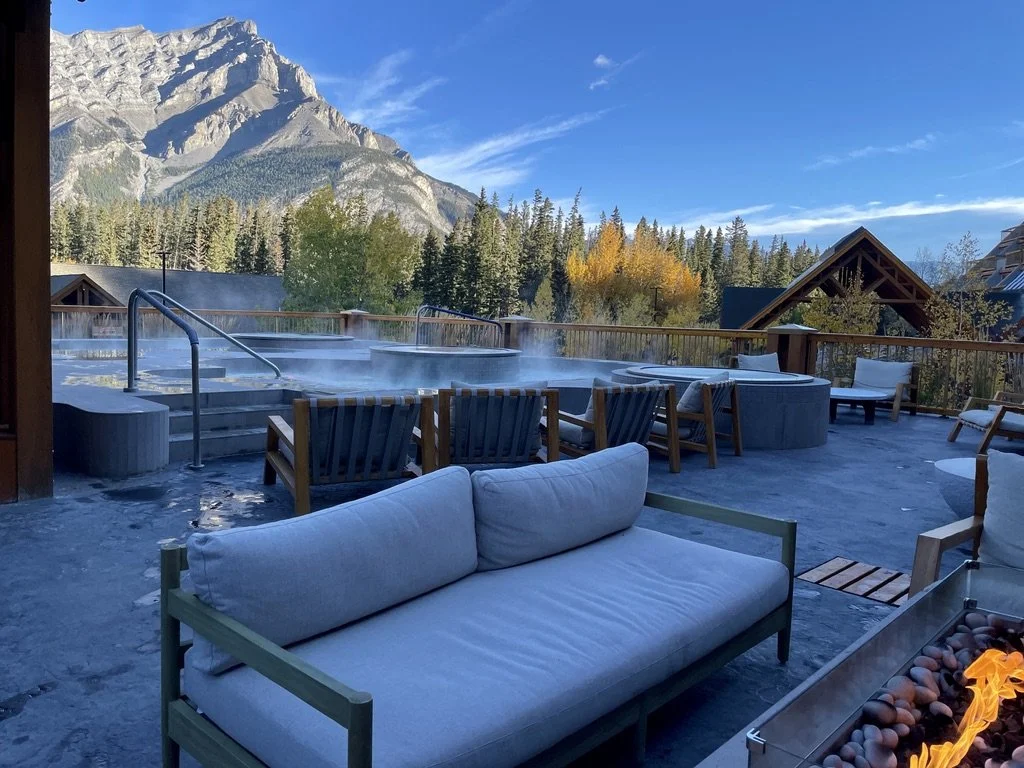
After breakfast dip. Otter Hotel, Banff.
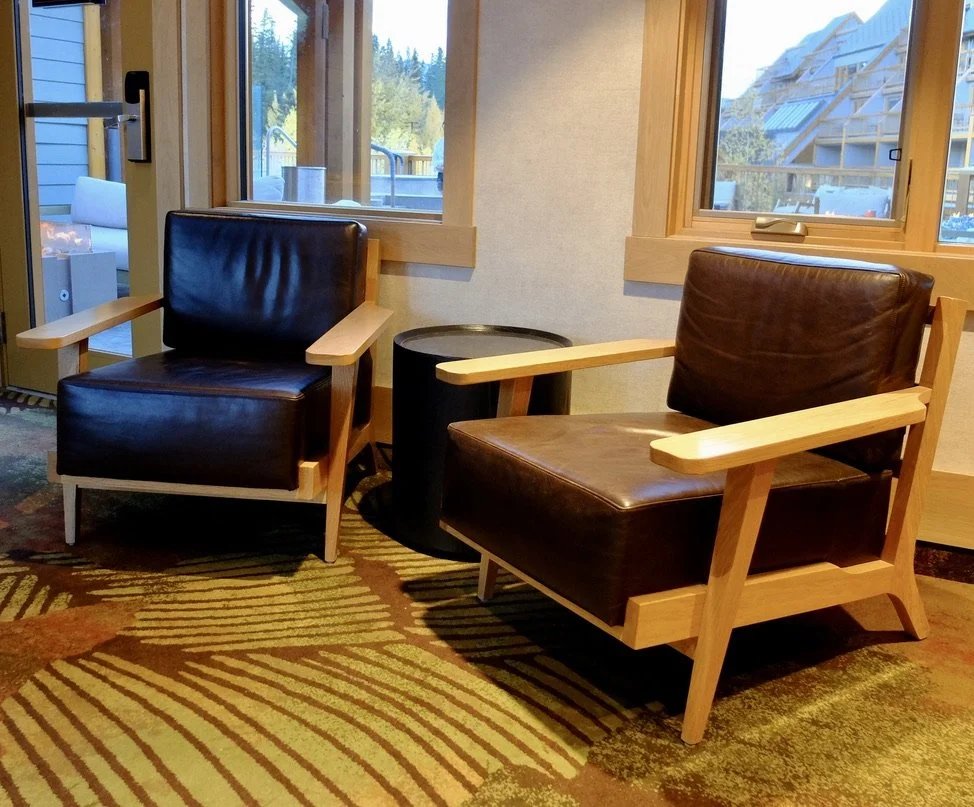
Otter Hotel, Banff.
At the Brewster Transportation Centre in Banff. Brewster Open Top Touring Bus retro style modeled after the original fleet from the 1930's that the Brewster Brothers used for their tours.
This was the Brewster bus we’d be taking to Lake Louise.
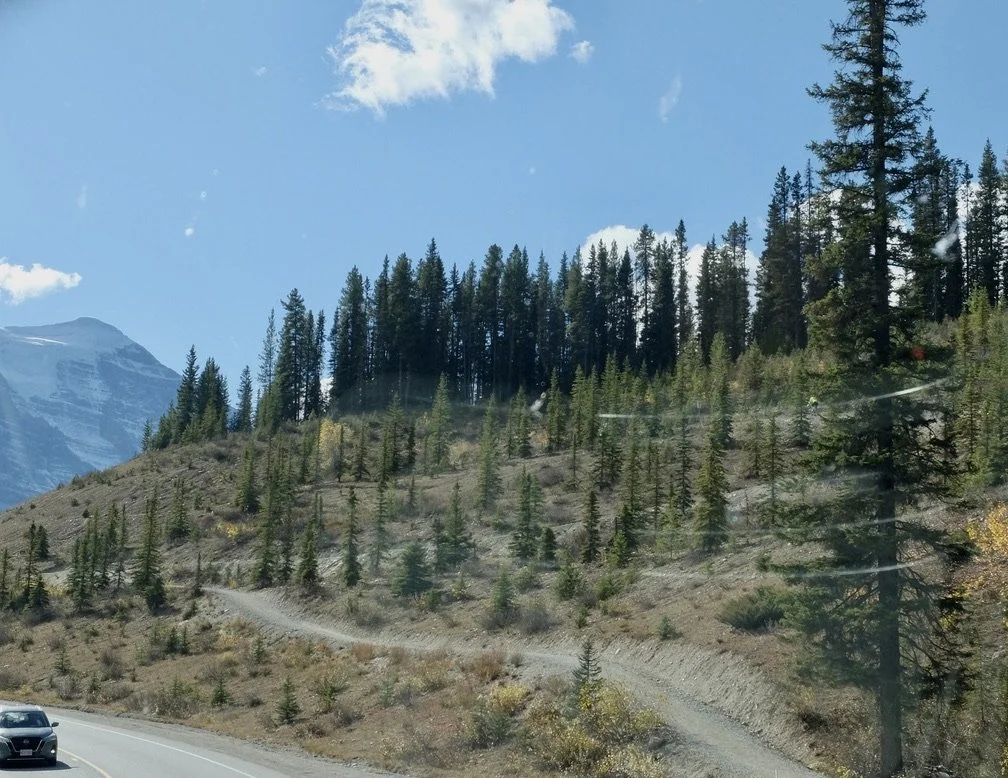
Drive to the Fairmont Chateau Lake Louise along the Trans-Canada Highway. Once again I have the front seat.
Our driver was a very nice Filipino fellow.
The Trans-Canada Highway that we had just exited to drive to the Fairmont Chateau Lake Louise .
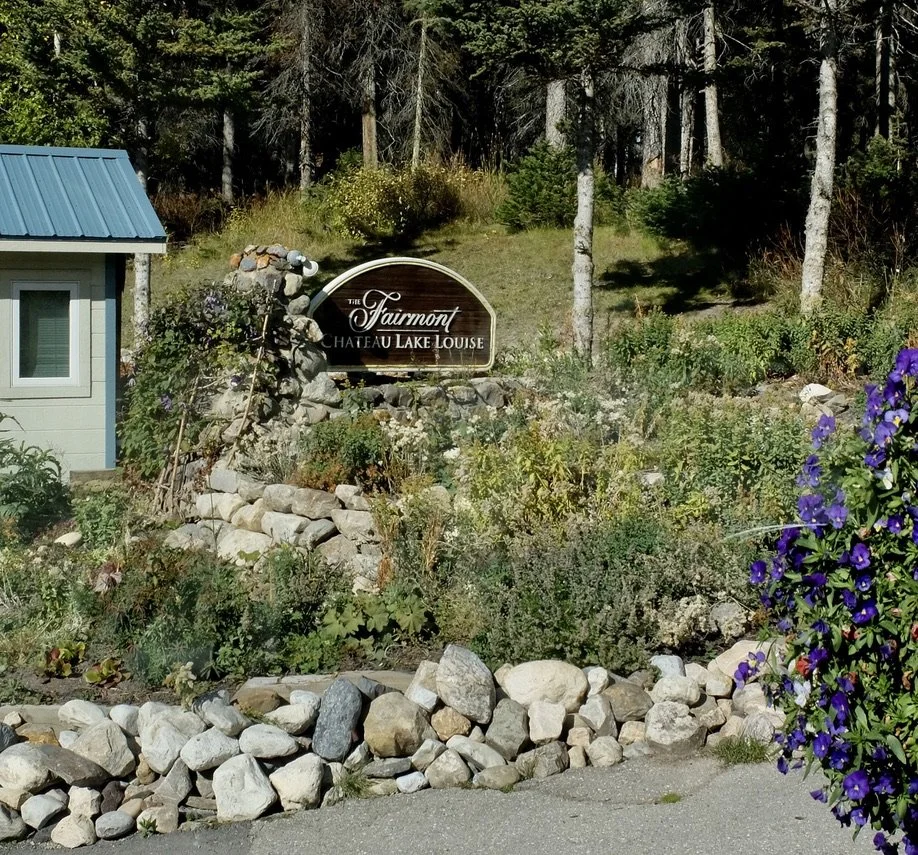
Near the entrance to the Fairmont Chateau Lake Louise.
Can you find the mountain bike rider?
One of the highlights of our Canadian adventure.